Enter 'the tunnel' with Steve, a Madison Avenue man of mid-50s America; a family man, but one who's prone to finding himself in a dark state of mind.
Whilst making the long trip out of town to pick up their kids the couple are slowly torn apart with a final, terrible consequence. The motorway becomes a metaphorical track from which no respectable man dare deviate. Each bar en route beckons as Steve seeks salvation in booze, his urge to drink, to be free to do so, driving the wedge between him and his wife ever deeper as the miles roll by and bitterness grows.
The Hitchhiker picks Steve, who sees him as a symbol of freedom, someone not shackled by either office drudgery or domestic strife. The tone is noirish throughout, by which I mean I could see it as a Robert Aldrich film as I read; faces lit by the dashboard and the pulsing light of oncoming traffic, illuminating the tension etched on their faces.
Simenon's prolific output does nothing to diminish his razor sharp prose and probably fuels it when it comes to economy of words applied for maximum effect. One thing he does brilliantly in this short novel is depict the gradual descent into drunkenness of a man in denial of his condition. But as Simenon writes at the beginning, this is a man who, when in that dark, 'tunnel' state of mind, never admits it to himself.
The outcome of the dark journey is powerfully depicted, with Simenon offering only the faintest glimmer of light at the end of the tunnel.
New York Review Books republished it as Red Lights in 2006, but I was lucky enough to find the Doubleday first edition pictured above. It's distressed condition perfectly matches the mental state of Steve and his wife.
'Read. Learn. Destroy'. Not a bad motto.
New addition to the Lemmy Caution collection. Peter Cheyney sitehere.
I posted anotherhere featuring the Jean-Luc Godard connection.
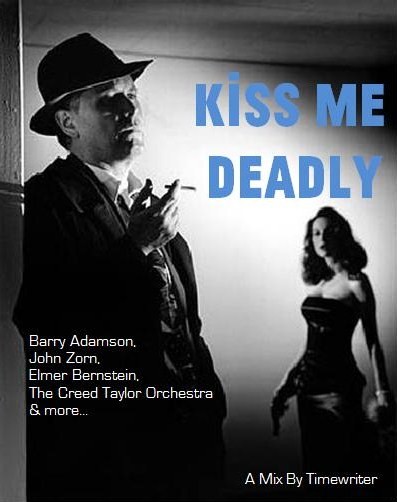
The pulp fiction and music connection can be made here, where I posted a Mickey Spillane book of mine along with a mix called 'Kiss Me Deadly', which has been re-upped.
Long-running detective Sexton Blake swings into the 60s here from the pen of W. Howard Baker, who revived Blake in 1956. I posted from a collection of earlier Blake storieshere, not that I've got a thing about the character, just vintage detectives, you understand. Howard had a knack for snappy titles, as you can see here. Anyone who calls a story Dark Mambo is all right with me. I've posted the cover to that below, culled from the Net.
I found this hardback last week, a snip at £3.50. Five issues of Union Jack are reproduced in their entirety, along with one Detective Weekly. Union Jack, a story paper, ran from 1894 until 1933. Detective Weekly ran from 1933 until 1940.
First up a great Crime Jazz album from Enoch Light (& the Light Brigade!). Enoch strays from his usual Easy territory into the dark back streets with sassy brass arrangements and big hitters like 'The Gang At The Green Grotto' and 'Dirty Work Underfoot', along with irresistible titles such as 'Blonde Bombshell' and 'Gum Shoe Lullaby'. What a cover! Recorded in 1959. If you want it, Listen Hear.
Yes, it's Hammer time (sorry, couldn't resist) - the soundtrack to the TV show, tunes by Dave Kahn & Melvyn Lenard, arranged by Skip Martin. 'Coffee House' has been a long-time favourite of mine but the whole album is as solid as Mike's muscles, and like his right hook, it swings! Listen Hear.
Since 'Tinker, Tailor, Soldier, Spy' is released here in the UK today, I thought I'd post these from my collection. Unlike Le Carre's novel, these were all written in the 60s.
Go here to see scans from the 60s classic, 'The Book Of Bond'.
‘I wish there was a special agency called Death that could hear what I was thinking and make a try for me. I’d like to take that stinking black shadow and shove his own scythe down his bony throat and disjoint him with a couple of .45s?’
Something I picked up the other day. Spillane wrote his first novel, ‘I, The Jury’(1947), in nineteen days. It sold six-and-a-half million copies (hardcover and paperback). By 1980 he’d written 7 of the top 15 all-time best-selling novels in the U.S. Even his stats are hardboiled. The writer as literary gangster, smashing his way into the writing racket and ruling it, spitting out words likes bullets from a .50 BMG – 450pm, drilling holes in critics, slugging members of the Shakespeare Squad – he made Papa H look like P.G. Wodehouse. I know a guy who’s only read one novel, and that was ‘My Gun Is Quick’. The nemesis of liberals, no time for depth of character, subtle nuances, or the niceties of political reason, he was an atomic author, a wham-bam wordsmith – the all-American way – get rich quick and to hell with everyone, especially the critics.
My 'Kiss Me Deadly' mix is now available as a download.
‘War and Peace’(1,296 pages), ‘Atlas Shrugged’(1,200), ‘Infinite Jest’(1,088) – I’m tempted one day to go into a library, request them all, and in homage to Tony Hancock use them to stand on in order to reach ‘Lady Don’t Fall Backwards’. As long-term readers will know, I’m partial to Galton and Simpson’s joke, perhaps because it strikes a chord with me. Not that I’ve ever quite aspired to intellectual greatness in the way Hancock did, but there have been times when I’ve tried to take on literary giants, by which I mean writers of big books. After all, some of the greatest thinkers and novelists have said a great deal in relatively few words. I’m thinking Nietzsche, only because I have read him. And in fiction, Graham Greene, because I’m currently reading ‘The Quiet American’. Greene was right. He knew the length a novel should be. Big enough to contain ideas and interesting characters without excessive descriptions and a cast of hundreds.
Muriel Spark said: ‘Write as if writing to a friend and use a few words as possible’. I agree with the latter half of that statement, but I’m not sure that ‘writing to a friend’ is a great premise for novelists. It would limit the use of the English language, I imagine. Then again, it depends on who your friends are and how clever they are.
I did buy David Foster Wallace’s ‘Infinite Jest’ once, in the days when I occasionally felt inclined to undergo a literary endurance test. I wish I had kept it because it would make an excellent missile to launch at cats who stray into the garden and I like the idea of hurling 1,088 bound pages at a marauding moggy. The weight would ensure considerable distance should I be able to muster the strength to throw it, and you can imagine the impact. I would find it funny, anyway.
So I’m reading Greene because I’m not reading Jean-Patrick Manchette’s ‘Fatale’, which has recently been published, making it only the third of his works to be translated. I’ve been eagerly anticipating this book, but sadly, all it did was to cast doubt upon my belief in him as one of the great under-translated crime writers. I enjoyed ‘The Prone Gunman’ so much that people ask for crime novel recommendations it’s usually the first thing I recommend. ‘Three To Kill’ is good too, but ‘Fatale’...well, this girl gets involved in small town society and...nothing much happens. It’s a big letdown, and the writing, allowing for translation, is not that great. On the plus side, it’s not even 100 pages long, yet I gave up, and having just looked again, I gave up merely 20 pages from the end. This really is poor on my behalf. I must go back and speed read through to the conclusion.
Greene, on the other hand, succeeds once again in captivating me, as he always did when I was working through his novels over thirty years ago. Of all the writers I’ve read and loved, along with, say, Chandler, he is the most reliable. By this I mean, like an old friend, I can turn to him and seek a kind of solace when I grow weary of literature, all the words in all the books that fail to give me what I want.
Greeneland is not a happy place to visit, being full of mostly miserable, desperate, doomed, doubt-ridden characters for whom there’s no salvation in either love or religion. And whilst in the realms of the melancholy, Robert Burton said ‘How much more cruel the pen may be than the sword’, which is true in a sense, as anyone who has read vicious comments online will know. I also think it a little cruel of New York Review Books to publish an inferior Manchette novel, letting me down as they have. But they must think otherwise, obviously. They did, however, also publish Burton’s 17th century epic, ‘The Anatomy Of Melancholy’ (547 pages), which has proved incredibly useful over the years. It currently sits, along with John Dos Passos’s ‘U.S.A’ (1,184 pages), on top of the hard drive, holding up a computer speaker. Thick books do have their uses.
The bunker’s crawling with Italian cops and robbers – there are bodies in the library music and Miss Marple’s no use. This is something to do with the criminal side of Italian music, but I don’t know how, exactly, and I don’t care enough to research. More Italian cops have entered the sonic scene here recently, but this is currently the one being spun the most. It’s littered with great drum breaks, devilishly ‘groovy’ organ-playing, and plain good vibrations, so good they make you want to board a time machine back to Naples circa 1971, do a jewellery heist and flee whilst firing from the window of an Alfa Romeo before meeting up in a farmhouse, shooting your partners in crime and heading off to a villa in Rimini where your fur-draped beauty awaits. But after you’ve formed the beast with two backs she pulls a Beretta from her bag, locks you in a cupboard and makes off with the cash.
The old guard of films critics have been made redundant - long live the new democratic order! All opinions are valid! Suck on this Philip French!
Yes, I speak as one of the three trillion bloggers who, like so many termites, have gnawed at the foundations of the House of Professional Criticism and now rejoice in its collapse.
I doubt that directors care. Marty isn’t listening to me, or any other blogger. Unless one day when he’s really bored he Googles ‘Taxi Driver’, clicks through 53 pages and arrives at my opinion of his masterpiece. Perhaps 53 is a little optimistic since I doubt that IMO is that high on search engine hit parade.
Now that the barbarians have stormed the city they bring with them the sweet perfume of popcorn, and stain the floor with spilt Coke. They jam the empty bucket-sized carton over the head of the Pauline Kael statue and floss their teeth with a reel of film containing ‘The Bicycle Thief’ – hah! David Thomson walks by and they chant football fan style ‘Who are yer?! ‘Who are yer?!’ C and K aren’t the initials of The Greatest Film Of All Time, they’re the brand of your pants and perfume.
But hold on, do I talk of ‘them’ or ‘we’? Am I really part of the new order, or longing to belong to The Dead Critics Society? I’m neither, actually. That’s me, somewhere else, which is where I’ve always resided. I’m quite comfortable here, although it does have setbacks, and one of them is not belonging. Well, to hell with it.
I like the fact that over the decades there have been lists of films made up by The Critics which, when combined, give us, say, 50 agreed-upon Classics. Without them I would not have discovered many great films and may have wasted a lot of time watching rubbish. Guidance is a good thing. Yes. And now Everyone is a guide, a critic. So, imagine a youngster with little viewing experience coming across an Amazon list, or a blog, extolling the virtues of ‘Pretty Woman’. Yes, he or she is off on the wrong track for starters. But, you may say, suppose they love ‘Pretty Woman?’. Well then, they get what they want and deserve. And they are lost forever. I recently came across some poor sap who actually went to see ‘Get Him To The Greek’ because it averages a 7-star rating on IMDb. He gave it one star. Can you imagine being so clueless as to use the opinions of those people as a guide?
Don’t tell me ‘It’s all a matter of taste’. It is, but since when did you think that people packing cinemas to watch the latest blockbuster/crime/Rom Com crud were behaving wisely? Admit it, you have your own inner snob which calls them ‘wankers’ whilst the liberal, tolerant you happily allows other people to wallow in shit because you like to think you’re not a cultural fascist.
Regarding this matter of Taste, there has to be the will to appreciate the finer things in life. Where that comes from I’ve no idea. Your parents, peers, or an inspirational teacher, perhaps (I’ve heard they exist, but never met one when I was shackled to a desk). Yet the sad fact remains, dear reader, that many will insist on believing ‘Four Weddings’ to be an All-Time Classic. The same people who buy McFly tracks, presumably. And today, if you’re not careful with the mouse, you’ll come across fan sites for Hugh Grant. It’s a dangerous world, this digital domain. You can stray into some awful places that will taint your view of humanity.
But where does the rise of the New Democratic Order leave the Old Classics? Do they rot alongside their supporters, The Critics? Because this is about more than simply Everyone expressing their opinion here in Blogsville; it’s about the values the old guard treasured. They used such old-fashioned criteria as the standard of visual artistry, the literary merits of a script, acting, directing etc. And they could place a work in its historical, socio-political and cinematic context, of course, because they were clever, about film at least. And they knew, of course, that The People do not give a hoot about ‘The Bicycle Thief’ and Italian Realism, or the mise-en-scene, or any other fancy concepts (most haven’t grasped what ‘film noir’ is - the idiots!).
Once those values become completely redundant, the sluice gates are opened and all that ‘art’ is washed away. That generation, the so-called baby-boomers, will be gone one day, and who will shape or influence opinion then? Who will guide the ignorant towards the heights of Great Cinema? ‘Avatar’ and ‘Titanic’ fans, probably. To some extent, they already do. It will be a sorry world then in which the remaining few with anything like discerning taste will be locked away in their little rooms, forming a weird cult which communicates in code via the internet whilst praying they don’t get caught and prosecuted for downloading stills from ‘8 1/2’. It could happen.
Since I don’t believe in either/or scenarios I’m not advocating slavish adherence to the Old Critic’s list of Essential Cinema, god knows that would be dull and represent a sacrificing of all that makes us what we are as individuals. But, to throw it out in gleeful celebration of The Self Against Classicism seems to me to be just as bad. If your Self is anything like mine in this respect it can be a lazy bastard that likes nothing better than to be entertained without using a brain cell. That’s OK sometimes too, but the great, complex, deep and, dare I say, more profound things in culture (and life?) tend not to come so easily. Yes, a little, sometimes a lot, of effort is required.
Primitive man didn’t face this conundrum, and if we hadn’t created what we call culture today, neither would we (never let it be said that this blog is not educational). Mind you, when you watch ‘One Million Years BC’ you see that he did have to contend with dinosaurs. Other than that he was content to fuck and forage for food. And travel, probably. That is the total extent of my anthropological knowledge right there. And yet, if we look around, like Attenborough creeping through the urban jungle, perhaps we may still see this man (and woman)...ssshhh...there...in the dark...transfixed by images on the screen...watching ‘Get Him To The Greek’...
Sight & Sound Poll 1992
1) Citizen Kane Orson Welles, 1941 (43 votes) US
2) The Rules of the Game Jean Renoir, 1939 (32) FR
3) Tokyo Story Yasujiro Ozu, 1953 (22) JP
4) Vertigo Alfred Hitchcock, 1958 (18) US
5) The Searchers John Ford, 1956 (17) US
6) L'Atalante Jean Vigo, 1934 (15) FR
7) The Passion of Joan of Arc Carl Theodor Dreyer, 1928 (15) FR
8) Pather Panchali Satyajit Ray, 1955 (15) IN
9) Battleship Potemkin Sergei Eisenstein, 1925 (15) USSR
10) 2001: A Space Odyssey Stanley Kubrick, 1968 (14) UK
I’ve been tempted to pick this up a few times over the years but finally did so recently. The reason I hadn’t before was that I thought it would be a run-of-the-mill crime novel. I was wrong; it’s a very good crime novel, even though the film was constantly being projected onto the back of my mind, and the image of Michael Caine was Jack impossible to shake off. A film being projected is pertinent to the story, as you probably know. It turns out that, despite not being a Northerner, Caine was a superb choice, which is obvious from the film, but when you read the book you realise how right he was, being the king of ice-cool detachment whether he’s waving away a blubbering ‘bird’ or dishing out the violence.
Mike Hodges made a few changes when he rewrote the book for the screen, but nothing that really betrayed the source. The now legendary line Jack says to Cliff Brumby in the film: ‘You're a big man, but you're in bad shape. With me it's a full time job. Now behave yourself.’ Was originally ‘Cliff, you’re a big bloke – you’re in good shape. But I know more than you do.’ Brumby’s demise is less dramatic in the book too. Jack almost throws him over the edge of a balcony instead of actually throwing him from a multi-storey car park. Jack’s final scene is also different in the novel and I don’t understand why that was changed, but I’ll say no more in case you read it.
What you get in the novel is a sense of Jack’s roots in the North and his relationship with his brother. Since the medium of film necessitates brevity these elements are lost. Watching ‘Get Carter’ I actually forget that he’s a Northerner, but it would have been too much to expect Caine to come up with a London accent tinged with a Northern one.
One of the pleasures of the book is the feeling you get for the culture of the times. On the walls of Doreen’s bedroom there are ‘pictures of The Beatles, and the Moody Blues, and the Tremeloes and Dave Dee, Dozy, Beaky, Mick and Tich’. In Frank’s room there are books by J. T. Edson, Louis L’amour, Alistair Maclean and Victor Canning, amongst other paperbacks. The presence of Maclean resonates strongly with me since his novels were always appearing in our house around the same time. His records include Mel Torme, Band of the Coldstream Guards, Ted Heath, Frankie Laine and This is Hancock – such details are what novels can deliver and films rarely do, these markers of a person’s taste which represent something of their character. ‘Yobboes’ have ‘Open-necked shirts and Walker Brothers’ hair cuts’, which seem a little outdated by ’69, but that’s the North for you (ha-ha). Jack drives past ‘Woolworth’s and British Home Stores and Millet’s and Willerby’s’. Then there’s The Cecil pub, of which somebody had once said ‘they should advertise it as having ‘Singing till ten, fighting till eleven.’’ Well, perhaps nothing’s changed in that respect.
Yesterday I wanted to write about the pared-down reissue of Chris Carter’s ‘The Spaces Between’ but I started by talking about how six days into the month I’d almost spent my self-allotted amount of cash on cultural objects and went on: ‘How can I go for another three weeks without consuming (owning) more? Ah, the dilemma of the fortunate Westerner (I don’t know why I label myself ‘Westerner’, as if those in the East are still queuing for bread and living on cabbage soup!). But, you know, I have to remind myself of how spoilt I am in comparison to...the poor...the really poor...those evoked by my folks when I wouldn’t eat my greens (it was always Biafrans in the 70s and ever since, in my twisted mind, they’ve monopolised the starving nation...market? There’s no market involved, so forgive me, I don’t know how to put it). But cultural objects cannot be equated with the starving since the new release of old Chris Carter recordings would be of no use to anyone who’s hungry unless they got enough to sell them to tourists on a market stall...and then, they wouldn’t make much money from Chris Carter CDs, would they? Can you imagine them trying to sell early experiments in electro to American tourists? They’d have more success with...(tries to stereotype the musical taste of the average American tourist and fails...) Now that ownership is a click and download time away, what hope is there of battling the urge to buy? The space between buying can shrink to become scarily small, as in minutes. Right now I’m pleased with myself for not buying every Chris Carter album available this afternoon...but tomorrow’s another matter. Optimo’s release of an edited (for vinyl loudness) selection from ‘The Spaces Between’ created a surge of desire for more of Carter’s music. The earlier full collection now fetches a handsome price but the tracks chosen by Optimo are such a tease that, briefly, I considered spending what was asked (cheapest was about £27). Then I came to my senses. I can live without it. We can live without all this, if we retrain ourselves. That is, live with what we have rather than sell everything, although there’s a case to be made for living like some romanticised hero from the past, ie, out of a suitcase, carrying only a battered Remington...check into 9 Rue Gît-le-Cœur, The Latin Quarter...and write your masterpiece... How did they survive, these cultural icons/heroes? They were not trapped by consumerism, therefore did not miss a collection of CDs, DVDs and books. Perhaps this freedom allowed for the greater capacity to create. I’ve a theory that selling everything would have an astounding effect on my creativity...but I don’t think I’ll be testing it out.’
Then I decided not to post that part. I’d got too distracted. Perhaps I was putting off talking about the music on ‘The Spaces Between’ because I didn’t know what to say and, more to the point, I was wary of commenting when I’d only just played it and you know how it is, when new releases excite you to such an extent that you feel like telling the world you’ve heard The Best Album Since ______.
One day and several plays later the seven tracks still sound superb, which is a relief, even though I didn’t go ahead and shout about it yesterday. It’s a relief because replays have, if anything, increased rather than diminished my pleasure.
These tracks were recorded between ’74 and ’78 represent the promise of things to come if you view Carter as a pioneer and precursor to Techno, Electro, Electronica etc. What followed more closely was the increased use of this gear and these rhythms in the rapid evolution of late-70s electronic Punk into 80s Pop, of course. But I refuse to blame Chris for the crimes committed in that decade. Were Kraftwerk unwitting Frankensteins? Maybe.
This material proves that although multi-gadgetry of the advanced kind is great it’s no substitute for musical talent. Apologies for stating the bleeding obvious. It sounds old in a charming way (the drum machine dates it) but Carter was an early user of the 303 and 808. I’m trying not to use the phrase ‘back to the future’.
Despite the Kraut influence there’s a sensibility that marks it as another beast altogether. For starters, the tracks are not 24-minute-one-side-long grand gestures of cosmic sonic exploration, but concise creations akin to John Carpenter pieces. And when I say ‘charming’ I don’t mean light-hearted because much of it has dark under/overtones. I won’t pick a highlight or discuss individual tracks, just end by saying that if you love electronic music you should get this release.
Winterbottom, like Affleck’s bad cop, pulls no punches in ‘The Killer Inside Me’. Look how nasty violence can be, he tells us, as another sickening thud accompanies one more knuckle sandwich delivered by the killer. Thanks, Michael, I never knew how bad it was until you showed me. What he really showed me was that you can have too much of a bad thing and that directors shackled by censorship were forced to come up with more imaginative ways to depict what happens, to the benefit of the audience, surely.
Perhaps Winterbottom felt that he was filming for the really stupid and desensitised, in which case, thanks again, for patronising me. What kind of oaf needs a lesson of that kind? The popcorn-munching, Coke-guzzling teenager? Maybe.
Affleck’s got the look to play a stone-cold killer, but if I’d been watching this at the cinema I think I’d have begun to feel as sore around the backside as his victims. I got bored halfway through, thinking of what the Coen brothers could have done with it. But they’ve already mastered noir and the American Western psycho.
Here the cop’s internal monologue is supposed to go some way to addressing the problem of translating Thompson’s masterful prose into the visual, but it fails. Thompson’s classic was brutal, but bereft of the writer’s ability to be inside this killer, Winterbottom leaves us with a cipher for evil rather than a real character. Most unbelievable of all were the lovers so devoted to this man. Here, if we give any thought to it, their fondness for him is not justified other than in some slurpy love scenes and shots of Affleck smiling in their company. This killer must have had a lot of charm, charisma...something. Instead, he’s all inside out and we don’t see what they’re supposed to therefore the relationship’s make no sense. Is the fact that he likes to play piano and listen to classical music supposed to reveal the sensitive side? Read the book instead.
Hemingway’s ‘The Killers’ was first adapted by Robert Siodmak to create a classic noir in ‘46, then Don Siegel got a shot at it in 64, supposedly for TV, but it was deemed too violent so it got a theatrical release. Too violent then is nothing compared to today’s standards, of course. It’s most famous, perhaps, for Ronald Reagan slapping Angie Dickinson, not just because in retrospect it appears incongruous, but because it’s a slap that carries a lot of impact. Michael, less can be more.
Winterbottom could have learned something from Siegel’s handling of the scene in which the killers deal with the blind female receptionist. Here, the depiction of evil behaviour is not lessened by the absence of graphic detail. Yes, we have to use that old-fashioned facility called imagination.
Dickenson’s femme fatale, exposed in the glaring light of day and full colour, is no less alluring than her noir predecessors, of course. If anything, her radiance heightens the contrast of what lies in her dark heart. Lee Marvin can always convey the killer superbly, without having to actually do anything. And watching Reagan play the bad guy is fascinating in itself. His woodenness seems to be an advantage as a ruthless criminal.
The best shot comes towards the end, when Strom (Marvin) gets out of his car. All we see is the ground, shoes, then blood dripping onto the pavement. At times it looks like a TV film, but Lee and Angie make it very watchable, and Siegel is no slouch when it comes to direction crime films. Cassavetes is good enough as the desperate speed freak, but he should have known something was wrong when someone as beautiful as Angie plays the driver groupie. He wasn’t the one taking her for a ride.
Writing mostly in the 2nd person (‘You lean up against a rough wall, light up a fag..’) Coover succeeded here in putting me in the same shoes as his private eye, by which I mean I got completely lost and staggered from page to page, dazed and confused from about the halfway point. With the kind of perseverance required by all good gumshoes though I stayed on the case, simply because the prose is so stylishly good. In that respect, this is as much a homage to Chandler as it is to the iconography of film noir. This is most obvious by the nerve displayed in calling his PI Philip M. Noir. As a testament to the skill with which Coover rattles of the poetic pulp prose, he gets away with that. ‘You’ being the central character helps, of course.
Chandler famously pleaded ignorance when asked who was responsible for a murder when Howards Hawks was filming The Big Sleep, and like good old Raymond, I too shrugged off plot details as I kept on walking down Coover’s hallucinogenic mean streets. ‘Everybody’s on that train. Nobody’s an original. To be obsessed is to be a wound-up actor in a conventional melo, with everyone else, the lucky ones, bit players at best. So it’s not the story you’re trapped in, like everyone else, but, once aware of that, how you play it out. Your style. Class. The moves you make.’
Coover could be commenting on the dilemma facing any contemporary author trying to rewrite the golden age of detective fiction in the post-modern era. He places every chip on Style and wins, for me. He’s great at doing what the best crime writers did, which is capture the moody city at night and the presence, the character of the streets and the metropolis. It isn’t set in a particular time or place, which heightens the whole dream-like aspect of the book. How much of this is dream, how much memory? Time slips...in such a way as to recall Philip K Dick as much as Philip Marlowe.
The book is as much a puzzle to me as the case Noir is trying to solve. How much of this is down to my failings or Coover’s skill I don’t know. Anyway, I’ll be reading it again because as far as I’m concerned, The Case of the Vanishing Black Widow is not closed.
I think it was Mingus who said that jazz should be the sound of surprise – well, you could apply the same sentiment to all music, assuming that just occasionally you want to be taken aback by a track that says something new and unexpected. Oh I love the sound of a well-tuned genre piece as much as anyone, but after what feels like a few centuries listening to music, the sound of surprise is still something special. Yeah, you get jaded by everything from time-to-time having heard it over and over, although I should say that Mingus has never made me feel jaded.
Anyway, Gultskra Artikler’s ‘Kasha Iz Topora’ album surprised the hell out of me, partly because it’s not in the electronic mode of ‘Qwerty’, but mostly because it sounds like nothing I’ve ever heard, although there’s a mood about certain tracks which recalls what you might call Modern Classical. That’s probably put you off. A bowed cello haunts ‘Begushema Vpered’, but not to the extent that it dominates because there are all other manner of scraping, rustling and creaking, along with a one-not bass motif towards the end.
You see, beginning to describe what’s going on here is virtually impossible. As for slapping a genre on it, I refuse (mainly because the only one applicable would probably put you off). His does get rhythm going on ‘Slovami Poeta’, a string-driven rhythm, but he’s too wrapped up in the idea of surprise to let that run for long. Strange things go bump, whizz, clang all over this recording, and they rattle, clunk, hiss and thump too – but lest you think this is some kind of Improv affair, think again because it’s all orchestrated, organised, placed precisely to create an atmosphere of other-worldliness and, of course, dreams or nightmares, of a mythic world, perhaps; one which we can visit but never fully enter because it exists solely in Artikler’s head. It’s not Improv (I say again) or Jazz or Rock or Electronica or anything so simple. It is what it is; a work of brilliance.
A Russian (Khrushchev) crops up again in ‘Double Take’, which had me all excited at the prospect of a film in which Hitchcock meets his double to a backdrop of Cold War footage which, I thought, was going to tie the whole story in – well, it didn’t. Not to my eyes anyway. Turns out the story by Tom McCarthy is good (Hitch meets Hitch to discuss Life, Death, Time, Film and all that), but the use of the footage made little sense. ‘The Birds’ is used extensively, although I don’t know why in relation to the story. Perhaps they couldn’t get access to all the Hitch films. Khrushchev and Nixon’s meeting is used a lot, but again I couldn’t see the relevance – at which point I began to think either the director’s smarter than me, or not as smart as he thinks he is. That old footage has been seen a million times before to illustrate the absurdity of the Russia vs America scenario, along with old TV ads or public info films etc, you know the kind of thing. The best is definitely Hitch’s wry quips to camera taken from his TV shows. In the mix is Ron Burrage, the Hitch lookalike used, shown getting ready for filming, or talking about life as a Hitch double. All that did for me was to ruin the illusion. You can’t have it both ways, the fantasy and the workings of it, not in my book. Perhaps, fittingly, I should watch it twice because it got such good reviews.
Funnily enough, I’ve got my own doppelganger. He looks so much like me that he fools the police, so he must be quite a resemblance. Or, conversely, I fooled them and bear a great resemblance to him. Well, who owns the copyright in this double-take game?
Anyway, the law stopped me in the street about 30 years ago, to ask how long I’d ‘been out’. Out of where? The nick. It took me half an hour to convince them that I wasn’t the criminal they thought I was. Imagine it. I’m on my lunch hour, being grilled, in a jocular manner, about my identity. I wonder if my double’s ever been stopped and congratulated on having a book published, or praised for playing a blinding set the previous night? Not that either’s happened to me.
As if that wasn’t enough, about twenty-five years later, I’m walking down the street near our flat when a car slows to a halt and out come three beefy blokes, the one in front reaching for his back pocket as he crosses the road until he stops just feet away. By that time I was primed to run but he apologised, showed me his badge and said they were looking for someone. The law, again. Had my double also been seen in London, I wonder? The previous incident happened in Aylesbury. Perhaps he’ll turn up on Crimewatch one night. Then I’ll be in trouble.
Finally, whilst crossing the forecourt of the local garage a few years back I heard someone calling out a name, not mine, obviously, but he persisted until I turned around and he apologised. Can I have three doppelgangers (is that a contradiction in terms?), or just one who gets around? It seem incredible, but I’m starting to think it might be true.
I’ve been thinking about Jean-Pierre Melville since watching ‘Le Cercle Rouge’ at the week-end. Is he that great? Is the film really a masterpiece? I only wonder because a lot of people believe both and I’m open to the idea but not fully convinced. Oh, I love the style of ‘Le Samourai’ but part of me thinks that’s its sole asset. My main memory of it is Delon being tailed...for what seemed like an age. I would have told JPM to edit that...though I don’t suppose he would have paid any attention.
‘Le Cercle Rouge’ is eminently watchable, not only because Delon is probably the handsomest man in the world (even with a ‘tache) but because it looks so good in those cool muted colour tones.
There are odd things, though, like the brilliantly surreal invasion of the marksman’s room by various crawling beasts, which I expected to have some significance later, but it didn’t. There’s no explanation of it, so I presumed he’d been a junky or something. He’s a mess who suddenly cleans himself up when hired for the robbery. I thought, at the crucial moment, he would start seeing iguana’s scampering across the floor of the shop. I mean, that’s what I would have written into the film, you know, to create some tension...will he hold his nerve? Or crack up and miss?
You see, I really could have made Melville’s films so much better than he did...apart from ‘Bob le Flambeur’, which is all-round great...and ‘Le Doulos’...which is hard to improve.
There’s also the mystery (to me) of the detective’s cats. Twice we’re shown him feeding them when he enters his apartment. Why? How is that scene necessary? How does it move the story along or illustrate the character? Film students: discuss.
I read somewhere that the film’s been butchered for release but I can’t believe it was cut to the point of rendering Corey’s relationship with the mystery woman (only seen hiding in the room of a man who owed him money) meaningless – what was all that about? There’s also a strange edit when Corey shoots the man in the poolroom. One shot, rapid and brief cut to dead man’s face. Was he trying to throw in something Godardian? A reference to nouvelle vague?
The best scene is the robbery, a homage to Dassin’s ‘Rififi’, presumably. No dialogue at all, or music; which makes it all the more realistic. As I said to LJ at the time, if this was a Hollywood production there would be some wah-wah guitar at some point...and possibly ‘tense’ orchestration (as they would describe it on the sleeves of library records)...Lalo, probably, which is no bad thing in any film, except this one.
As a bonus, Eric Demarsan’s soundtrack is a superb updating of classic Noir jazz. I bought it a few months back, so I had the unusual experience of knowing the music before the film.
So we all differ sometimes in our opinion of supposed classics. I’m sure there is someone out there who doesn’t rate ‘Citizen Kane’ that highly. Then again, that sounds ridiculous. If there’s a certainty in critical appraisal of cinema, it must be that Welles’ film is a masterpiece.
As for ‘Le Cercle Rouge’, I’m still not convinced that it’s the classic crime film many so-called ‘experts’ think it to be.