Showing posts with label Music. Show all posts

Monday, 19 March 2018

Modern Music is Rubbish! (?)


There comes a time when you really have no interest in such things as 'Junglepussy In the city centre of Ghent, in northwest Belgium' (Quietus headline today). This time comes earlier in some people's lives than others. To say I have only just arrived at that point as I near 60 would be a lie. For a few years now (how many, I cannot count because a gradual development has no definite beginning) I have had such thoughts when faced with contemporary music news.

I could lay the blame, not on Mame, but J.S.Bach; to be precise, his cello suite No.4, which I started playing half an hour ago. It took less than a minute for me to think what all great music is capable of making us think, namely: "This is superior to everything" (except the relatively few other truly great pieces of music I own). The subject in the back of my mind is how middle-aged listeners relate to contemporary music, not that which inhabits the narrow specialist field they may still explore should they be interested in contemporary music, but the 'contemporary' as covered by the larger sites.

Unfortunately, even defining 'contemporary music' is not as simple as it once was, in the olde days when vinyl was all we had. That cassette-only album (but on Bandcamp) your Noise-making friend released recently is still, basically, contemporary music. But the fact that it will not even register on supposed indie-minded sites means that, by inhabiting the very furthest margins, it is beyond being recognised in the contemporary field. 

Pop music may not be aimed at my age group but that does not stop those within the demographic occasionally (or even frequently) blowing their tops about the state of modern Pop. Within most of us there's a trip mechanism liable to be set off at any time by the mere appearance on screen of a modern Pop star as, say, part of of newspaper's front page. Watching coverage of Glastonbury is asking for trouble, yet sometimes we do so to reaffirm prejudices.

We know that musical appreciation is subjective but that doesn't prevent us from making 'definitive' statements sometimes, by which I mean statements which we are convinced are correct, 100%, no question. This is problematic if one tries comparing say, Slade to Ed Sheeran. Both made/make music for teeny boppers. The thing here is that one made music for me, when I was a teeny bopper, which immediately makes Slade better. Ed Sheeran will be better, in 30 years time, for those who love him now, than whoever kids worship then. Apologies for stating the obvious but part of this process must inevitably be the laying out of facts in order to try and find a truth.

As I said to friend in a pub recently, the only chance contemporary music has of trumping what's gone before is by using new technology in such a way as to truly make something new. But it is only those who have 'heard it all before' who must endure that curse/blessing. Yes, we saw Bowie's first Top of the Pops appearance when it happened and we watched the Sex Pistols 'live' on the Bill Grundy Show. Perhaps we also felt the rush of Jungle when it was new and so on. Such experiences taint us terribly, partly because they are firmly placed in the museum of groundbreaking Musical Events. Those who place them there will be from various generations, of course. Older (than me) people will have seen Bill Hayley's first UK tour, Dylan's first electric set and so on. 

What irks some of us, after a few decades, is the site of further additions to that hall of fame. It's as if we have the right to lock the doors of that museum when we think there can be no more worthy additions. One case that springs to mind is is the 90s 'Cool Britannia' phenomenon. I remember well that neither Blur nor Oasis were thought of as actually groundbreaking, original or sensational by seasoned veterans of the listening game. The former were 'mockney' jokes, the latter, Beatles imitators. With some catchy tunes. You don't need me to tell you that for many they too are now deemed worthy nominees for the Hall of Fame. Well, they're already in there. 

As far as the professional music press goes it serves them to maintain a continuum of Great Music for obvious reasons. People's earnings depend on it. This is no cynical conspiracy by 'old' editors, but simply a matter of employing young writers and letting them be enthusiastic about all that music which sounds fresh because to them it is despite easily available evidence to the contrary. 

Although we have the potential for rational thinking, we humans are prone to being irrational. You've noticed? Rational thought and logic aren't easily applied to music. It takes a very cool head to be rational about all this. But isn't music supposed, among other attributes, to arouse a degree of passion? The very thing about the music we love is most likely to blow rational thinking away. There are few greater sounds, for instance, than a Charlie Parker solo. Agreed? Of course not, unless you also happen be a fan. 

Perhaps, when all is said and done, talking/writing about music is a futile exercise. Here on Include Me Out I've written a great deal about music yet I could not begin to describe/explain what it is about a Charlie Parker solo that is so very special. Professional Jazz critics could explain it technically, but no more define the mysterious thrill than I can.

I may think them 'wrong' but I enjoy hearing friends declare a Frank Zappa album to be mind-blowingly brilliant. What worries me more (here's the crux) is seeing the same comment tagged onto a Level 42 album on YouTube. OK, they were a random choice, of course. It would be easier to say Kanye West. Or a contemporary Pop group, but I couldn't name one. Do Pop groups still exist, or are they a dead breed, replaced by solo artists? Is it time for bingo yet, nurse?

My final point is that I'm as capable as any idiot of declaring modern music (within the general field) to be RUBBISH!...
...(Starts shouting) I SAW PARLIAMENT/FUNKADELIC, ORNETTE COLEMAN, THE ART ENSEMBLE OF CHICAGO (original line-up), THE CLASH (SUPPORTED BY THE SPECIALS) AND THE THE RAMONES! I WAS THERE WHEN THE ZIGGY STARDUST ALBUM, ROXY MUSIC'S DEBUT AND 'NEVER MIND THE BOLLOCKS' WERE RELEASED! I DANCED TO THE FIRST 12" DISCO RECORDS! (Internal editor: "Stop, this could go on for ages"). AND YOU EXPECT ME TO GET EXCITED ABOUT MODERN MUSIC???!!! IT'S LIKE VISITING THE SOUTH OF FRANCE THEN BEING FORCED TO LIVE IN BLACKPOOL!

You see how easy it is? To return to J.S.Bach, as he once said: If I decide to be an idiot, then I'll be an idiot on my own accord. The best I can do it restrain myself as often as possible.

Thank you


Thursday, 14 September 2017

Let's Get Physical (Graffiti) & Nico's Political Incorrectness


"No-one wants CDs anymore" said the woman working in the charity shop. What? Even charity shops have turned their back on the old format? Well, this one had anyway. Streaming and free files have killed the CD, which now has the same status vinyl had ten years ago, exceptions being the niche home-baked, hip independent limited edition type. As for everything else, the more common stuff, it seems to be available at very reasonable prices second-hand. Vinyl, however...well, you know the story.

The absurd value placed on vinyl today is a good thing for those of us who've been buying it since the 70s. It means that, should we be a little cash-strapped or, in my case, wanting a book that's a little expensive, we simply cull the vinyl collection and sell to trade shops for prices we'd never have got ten years ago.

Meanwhile, I've taken to buying CDs again, mostly in charity shops. Don't ask why; I suppose I'm perverse that way. Plus, all that stuff on the hard drive is great but you know how that goes. Whereas the physicality (ha-ha, that's what they say about vinyl) of the jewel case is something else...more...demanding. Yes, ironically, when people compare the effort needed with vinyl to the ease of mouse-clicking the third (seemingly forgotten?) way is the disc in the case and the medium it requires, the hi-fi (I think that's what they're still called). Nowadays I regularly burn files to disc to lighten the hard drive's load but more to the point hear music on a better system.

Talking of physical, yes, this morning's purchase was Led Zeppelin's Physical Graffiti, the vinyl version of which I sold last year. This CD double is a suitably hulking (for CDs) thing. Of course it doesn't have the charm of the original card sleeve's clever images-in-windows design but I can live without that.

The case is ugly, but then, so too is the music, in a way. Playing it again, I was reminded of what a monstrous beast Led Zeppelin were. I mean, the sheer excess of mid-70s Rock behaviour, matched by the grossly overdone riffs and solos...the slow drag of In The Light...the folksiness and the clunky funkiness. But then, the grotesque weight of it appeals to me, as does the production, which is both raw and somehow...grimy. 'Originally recorded on analog equipment...to preserve, as closely as possible, the sound of the original recording' it says on the back. I thought the idea of CDs was to improve the sound! Confusing, isn't it? Crisp, clean digital precision versus 'the original sound'. So which I'm hearing is a mystery. That's alright. The best of it still sounded great, played loud, of course.

Again, what was said in a charity shop: this morning, as I paid for Physical Graffiti, Velvet Underground were playing on the sound system. I couldn't resist sharing my admiration for them with the girl behind the counter. She replied by saying she could only play them because the manager wasn't there and went on to explain that her boss regarded Nico as a racist, therefore banned. I suggested that presumably Wagner's music could not be appreciated either before a quick summary of my thoughts on politically vetting artist. She smiled, not wanting to engage in a deep discussion, which I didn't either. I'd said my bit and walked out, thinking about all that.

Firstly, I had no idea Nico was 'racist', but having since read a little about her and it seems she made a few suspect comments. Secondly, if anyone wants to shun an artist for comments made off the record (literally) that's their business. When they make racist records that's another matter. Of course, I can easily ignore what artists have said because I'm neither Jewish nor black. Neither am I gay. As a pro-feminist gesture, should I start researching my favourite artists' attitude and behaviour towards women? If I should ban those who are guilty of misconduct, how much music would I have left? That may seem like a selfish attitude, but so be it. If you wish to politically cleanse your collection, feel free.

Friday, 28 July 2017

The Fall at the 100 Club


Standing in the 100 Club last night Dan wonders "Is this the fall of The Fall?" Dan's in a band called Gutters. He's from Up North too, like Mark E. Smith, but is not quite as famous. Like Smith, Dan is a poet of the oblique and deserves recognition. You can hear his band's debut album here

I feel ashamed. A little embarrassed. Because 40 years later I 'get' The Fall. Please forgive me. I've been busy. Busy getting into Jazz, for instance. And Drum'n'Bass. Busy going off on tangents to find John Adams and Pierre Henry. Busy listening to anything but The Fall.

Last night I stood listening to The Fall because Dan had a pair of hot tickets for a show that sold out quickly and chose me to accompany him. I felt honoured, not only by that but being in the presence of Mark E. Smith. That would soon change. 

Now that I'm wise I feel stupid. How could I have ignored The Fall for so long? So I've spent some time watching interviews and documentaries, as well as listening. There's a lot of listening to do; so much that I feel I'll never catch up.

We're in the 100 Club, desperate for a view of the man but the stage is low, affording only glimpses of band members' heads but not Mark E. Smith, who's seated. It's ironic that having eluded me for so long, even when in the same room I still can't see Mark E. Smith. Serves me right. When I do eventually glimpse him between audience heads, lurching across the stage, mic so close to his lips as if he wishes to eat it, he doesn't look good. 

How will you look when your'e 60? Yes, but for 60, Mark doesn't look good. His face seems bloated, contorted in a kind of agony rather than anger. It's as if he is trying to devour himself and the audience through this ritual. Is he ill? Is he on steroids? Has a kind of illness plagued him since 1976 and the formation of a phenomenon that would allow him to try and exorcise the demons over the following decades? That hard exterior, was it always in place, having thickened over years of stupid questions from journalists and TV presenters? To be working class and not ordinary. To be dogged by dumb reporters always after an angle, never coming close to understanding what he's about, eager to pigeonhole and gradually feed on the enigma, to taunt, to mock someone who is contemptible of them.  

He has osteoporosis. Some audience members won't know that and those who are young may consider him a crotchety 'old man', albeit a legendary one. There's a danger of this being a freak show. The trouble with time and society's attitude towards the old is it turns us all into freak shows if we live long enough.  At this stage of The Fall's life, Mark E. Smith's one-man rebellion against the idiots is in danger, not of commodification or commercial appropriation, but worse, becoming a joke. Like Glastonbury, like Punk, turning into another spectacle, an ex-revolutionary alternative rendered impotent, merely another form of entertainment.  

Halfway through the set Mark E. Smith has gone AWOL. It's something we sense more than see. The word soon buzzes through the room. The band play on. He has a reputation for disappearing. Even I know that, but it's still a shock. Where is he? Is he that unwell? We were told later by security that he'd had an asthma attack. But his vocals resume. How can this be? Pamela Vander, his partner and manager, appears on stage shouting his name, encouraging the crowd and finally pointing to the far corner of the room, where the dressing room is, telling us he's over there. She proceeds to try and crank up the energy level of the audience with 'come on' gestures of her upturned hands whilst stalking the stage. It works. Someone throws a plastic glass and as the band play on I get a rush of excitement that reminds me of Punk gigs long ago. In his physical absence, Mark E. Smith has intensified everything. More than that, the band are playing tight, raw, high-energy, motorik-type off-kilter...Rock 'N' Roll! That's what this is. Not everyday, generic beat stuff for kids but deep, gnarly grind from a parallel universe version of 1950s Las Vegas strip joints fused with avant-garde Northen No Wave. 

The disembodied vocals of Mark E. Smith performing from the dressing room have set the whole thing off-kilter. It's as if we're witnessing a magic trick. As if he is indeed a god, or a ghost, communicating from another realm. The band had been strong so far, forward in the mix, perhaps to compensate for Smith's fragile performance? Without him on stage they more than rose to the occasion. I have read reports of crowds turning nasty when Smith has disappeared. They paid good money to see him, right? But here, at the 100 Club, that wouldn't happen. The band gave the crowd no opportunity to get frustrated and drove on. I for one was well and truly beaten into submission anyway.

That was my first Fall experience. It may be my last but it will certainly never be forgotten. Mark E. Smith and The Fall had been absent in my life for a long time, the fact that He came and went again so quickly seems fitting. 

Photos by Dan Cohen.


Postscript: I've since found out that the tall man standing near me who looked like BBC reporter Jeremy Vine was actually him. He's posted a short piece of footage on his blog.

Wednesday, 28 June 2017

Kurt Weill's Die Sieben Todsünden / Oneirika by zeitkratzer + ELLIOTT SHARP


on the day that I found Kurt Weill's Die Sieben Todsünden for 50p (need I tell you how good it is? of course not)


...it's appropriate that I should also listen to Oneirika by zeitkratzer + ELLIOTT SHARP - the berlin connection - would Weill have approved? who knows? (not of my pairing, but of the avant-orchestral Zeitkratzer) something about them tells me he...might? what a fantastic pointillist-action-sonic sound this is - all over - drums pound, saxophone scribbles (march of death like horrendously portentous on VI - of what? the death of something/war against something & to transport american Sharp's composition to berlin of cabaret-era berlin theatric the nazi national socialist death camp figurehead grinning in the wings). Really first class. even, at times, bernard Herrmann-esque horror strings plus everything that's great about Zeitkratzer, here taking a chance on John Cage (apparent inspiration for Elliott's composition) the upward/downward dance of strings on VIII is stunning...


otherwise, Oneirika offers everything you want from music (unless you're in the mood to dance/relax/hum along) - it's total music, all-encompassing, from deft atmospherics to a deluge of noise.

Monday, 19 June 2017

Terry Riley Don Cherry Duo


Calling all Planetary Dream Collectors, it is time to whirl dervish-like to the sound of Terry Riley and Don Cherry - and as the world spins around the axis we form, for once the terrible, chaotic blur of events (should you live in London especially) will dissolve, be dissolved by sound that is both moving (literally) and centred in a harmonious cyclical dance, enough to entrance and calm the most troubled minds. Riley's cosmic fugues defy/deny time, seemingly expanding it even as it is precisely measured, the opposite of waiting or watching, in his music every module measures what feels like instantaneous moments in an eternal flow. 

As I say that, I'm in danger of sounding as if I have indulged in mind-expanding drugs just as Riley did in the 60s. No matter, whatever it took to open and walk through the doors of perception it may or may not have created this sound as much as made it possible. Who knows? Did Charlie Parker need a fix to attain his sense of higher improvisational capabilities? Surely he was capable anyway, but can an artist and his life be severed so easily?

Here, on the first track, The Descending Moonshine Dervishes, fellow traveller of celestial roads, Don Cherry, proves himself a worthy partner, a man who was, as his track record proves, a free-ranging artist. So it is no surprise that his voice, although in some ways contrary to the rhythmic precision of Riley's, beautifully contrasts the cyclical pace. I'm reminded of the way Miles Davis would add restrained yet potent dimensions to sometimes frenzied collective noise. Here he may hold a note or mimic the bubbling keyboards. Whatever he blows it is in tune with Riley; you sense him listening and reacting.

Sunrise of the Planetary Dream Collector is Riley alone. I'm struck by the 'sacred' opening, as if a service is about to begin - or has ended? I shy away from religious analogies in music, usually, for fear of lending too much weight to something. Having said that, I confess to having 'preached' the virtues of John Coltrane (and countless others) in the past. I may even have said that whilst I worship no recognised (in the religious sense) god, I kneel (metaphorically) before the speakers when playing Ornette Coleman's The Shape Of Jazz To Come which, as I'm sure you know, also happens to feature Don Cherry.

Meanwhile, these two 'sermons' are worthy additions to your collection. It is sometimes hard to focus on sanity and this music, whilst taking you 'away', also has a unique kind of healing force of its own. You can buy it at Soundohm

Tuesday, 14 February 2017

Zeitkratzer performs songs from "Kraftwerk" and "Kraftwerk 2" / Christian Bouchard - Broken Ground


Reinhold Friedl's Zeitkratzer start their 20th anniversary celebrations by interpreting tracks from two Kraftwerk albums...but you can tell that from the title - I need more coffee -

No surprise that this is another impressive addition to their canon of covers which have previously featured John Cage and Stockhausen. Friedl's arrangements perfectly tease out the possibilities inherent in the originals, although I have to say that the opener, Ruckzuck, initially gave me cause for concern. It naturally lacks the bite, or edge or Kraftwerk's original rhythm and reminds me of common orchestras covering Rock (you know how awful that usually is). But they're only working, structurally, with what's there and you know that breakdown is coming; so how will they handle that? Brilliantly, with great great piano-smashing chords, before see-sawing off towards the end in fine style. The 'mood' pieces, such as Spule, work best, transforming the original 'ghosts' in the machinery into breathy tension accompanied by scraped strings, cymbal splashes and forceful bass notes. Atem is another treat; what sounds like an extended heavy breathing exercise coloured by minute sounds from other sources. I look forward to things to come this year from Zeitkratzer.


Commissioned by Derek Besant by accompany his 2012 exhibition, Broken Ground, Christian Bouchard's album of the same name features remixed versions of the original pieces and they're exquisite in the attention to detail he pays throughout. You might expect that from someone who studied at the Conservatoire de musique de Montréal and was awarded First Prize in electroacoustic composition. 

As I've said before and no doubt will again, to these ears, the technical aspect (the science of electroacoustic music) is but one (necessary) step towards realisation that transcends the study of sound to create sonic wonders. Hear Voids Patterns, for example, it's treated bell chimes (?), perfectly weighted against static crackle and electric whine. Throughout the works Bouchard shifts the emphasis from a relatively 'light' tonal palette towards occasionally stable rhythmic patterns along with bursts of guttural noise. The overall balance is towards weightiness but always there are counters, the kind which differentiate this music from, say, simplified Industrial electronics with which you could say this shares some common ground. I might call it 'Industrial music with a degree'...but that could sound stupid. Another superb release from empreintes DIGITALes

Monday, 6 February 2017

The Music of Marcel Duchamp / Film: The Dark Mirror (1946)


A Twitter notification from Boomkat this afternoon informed me of a new vinyl version of the music of Marcel Duchamp, for which I'm grateful, not knowing that any such recordings existed, or that he even wrote music, if it can be called written since, like John Cage's notations, I think they're open to interpretation. If you don't fancy the vinyl, an earlier CD version can be heard at Ubuweb.


***


Watching lots of films these long Winter evenings. Recently, Robert Siodmak's The Dark Mirror (1946), featuring Olivia de Havilland as twins, one of whom is a nasty piece of work. Thomas Mitchell as Lt. Stevenson gets a great line as he enters the psychiatrist's apartment to find him playing Classical music: 'I don't mind ordinary music,' he quips. 'It's the wonderful stuff that bores me.' 'That's snobbish, you know,' replies the doctor. I doubt the cop would have had much time for Marcel Duchamp's music, or art, for that matter. I recommend the film.

Tuesday, 17 January 2017

Pierre Boulez Conducts Schoenberg / Broken Record Art / Tod Dockstader: From the Archives


I don't think Arnold Schoenberg would have approved of the democratic voice the internet has given us commoners. 'Everyone is supposed to have their say,' he wrote in 1928. 'For the new bliss consists of the right to speak: free speech! Oh God!' Sounding more than a little fascistic, eh? But ironically I know what he means, especially if I allow my eyes to drift down to the Comments on any given YouTube clip. I'm sure you do too. It would be ironic for me to criticise this age of The People's Voice, being a blogger. Schoenberg was probably less enamoured with The People speaking because they would have more than likely not done so favourably if commenting on his music.

So here's a recent buy, Pierre Boulez Conducts Schoenberg, Eloy, Pousseur. Schoenberg's Transfigured Night was written in 1899, on the cusp of two centuries which would see him transform Classical music in the new one, or at least, create new possibilities. For as far as I can tell, with my limited knowledge, like so many pioneers in music he may have opened a door but few walked through in quite the same manner as him. Transfigured Night has one foot in the Romantic past and another, to these ears, is dipping a toe in the more challenging waters of the future. In adhering to the structure and story of Richard Dehmel's poem, Schoenberg had the opportunity to create unsettling sequences in keeping with the tale of a woman who committed an 'effrontery' when becoming pregnant by a stranger. Unlike her child, however, what Schoenberg would give birth to in the 20th century was not always warmly welcomed. In response to criticism, he mocked 'communally oriented artists' who 'addressed their idiocies only to each other.


***

Here's something I made late last year. It's not entirely successful, perhaps because I didn't finish it to my own satisfaction...


***


Emerging late last year, although I've only just got a copy otherwise it would have been in my Best Of list, Tod Dockstader: From the Archives on Starkland. What a phenomenal release, 15 tracks chosen from 50 which, in turn, came from thousands of files discovered on Dockstader’s computer after his death in 2015. My only regret is that more could not be heard; perhaps they will be in the future. That said, I believe in protecting the legacy of the deceased. At least Dockstader is in good hands, rather than the grubby ones belonging to profiteers who plunder the sonic coffins of Famous Dead Pop Stars.  

There's no chance of Tod becoming famous unless the listeners' world is turned upside down, thus placing quality electronic music on top (of the Pops). In this age of 'popular' politics which seemingly turns 'reason' and 'logic' upside down, music such as this becomes even more precious. Well, I don't know about you, but 
such sounds have always been private ammunition against Common Culture. Do I sound snobbish? A little like Schoenberg, perhaps! No matter, now I bask in these archival sounds, especially tracks such as Chinese Morf (2007) which, despite it's relative (to many electroacoustic pieces) brevity, encapsulates the spirit of acousmatic adventures in sound quite brilliantly.

Whilst it's possible to date (roughly) this music (yes it sounds 'modern') it stems from the tradition of 'unknown' sound sources. Is that a typewriter key striking on Todt 1? What is being 'played', or recorded, hardly matters. There is a temptation to hear these tracks, in hindsight, as largely melancholic mood pieces, yet there's also a magisterial power brooding amongst the more ambient moods. On Todt 1, Dockstader employs some mighty low end 'oomph' intermittently. Mystery Creak (a joke referring to Pierre Henry's famous creaking door?) is pure sonic delight, the 'creak' barely registering amid flurries of head-spinning sound. The whole 'creak/creek' sequence is magnificent. Big Jig (2005) closes the collection in storming fashion, Dockstader layering mechanoid metal-on-metal as well as any of the young Heavy Techno breed, succeeding in restraint rather than overload. Essential. 


Friday, 13 January 2017

Bartok Concerto / Post-Truthisms / Career (1959)


Recent vinyl find, in excellent nick and what a cover. Love the way the strict geometry of the cityscape lines dissolve into what looks like an abstract representation of an ocean with huge wave but is actually pure design effect to contrast with the rigid skyscraper forms. No artist credited. Aside from that, I like the fact that it's from Bartok's homeland, Hungary...


***

Post-truth everything, even the weather - forecasts of snow and subsequent freezing temperatures across London proved unfounded, thankfully, because it would have made my cycle ride to work tricky yet I couldn't help feeling betrayed by an overly-cautious BBC because what they said would happen didn't, just like they said the temperatures would plummet during the day on Wednesday so I warned LJ to wrap up - that didn't happen. I'm doubting the validity of all predictions. Post-Brexit 'disaster', didn't happen (although there's plenty of time for a slow-burn descent into economic sludge). Trump as president couldn't happen, it will. World War 3 won't happen either when he's in power, mainly because it's in the interest of Republicans to maintain their cosy lifestyles by not encouraging a large-scale war that escalates and goes nuclear. 

The new series of Question Time on the BBC has started. I became addicted to it late last year; fascinated by endless variations on the theme of evasion/defence/attack demonstrated by politicians. The sense you get is that the only honest people on the panel are the unaffiliated, politically. These are Political times. We can't escape it. So we read the 'papers, watch TV and then say 'Oh it's all bollocks'. That, in a nutshell, is why Trump won. No matter how much dis/information we read we're none the wiser and those who've already aligned themselves to a party won't change their minds. The rest of us just watch, zombie-eyed at the spectacle of 'democracy' knowing that our opinions can't be represented because they don't coalesce into convenient Left, Right or Centre thinking.  

***

Film recommendation: Career, 1959. Smart script, classy acting, even from Dean Martin, who plays the fine line between scoundrel and victim perfectly. Good cinematography and Shirley MacLaine looks fantastic. If you want a story about the conflict between trying to realise a dream and the price paid for being persistent this is a great one. 

Thursday, 12 January 2017

X(mas) Factor Irony Alert!


So I'm visiting my sister at Xmas and one of her daughter's girls asks me if I know what 'Dabbing' is but of course I don't so she proceeds to show me. Right. I like to keep in touch with what's happening, of course. Then she asks me if I've heard of Honey G, to which I reply in the negative, only to realise, when she shows me on her tablet, that despite trying to avoid being contaminated by the Popular Culture virus I did know who she meant.

This girl is around 15 years-old. I feel bad not knowing her age...the kids used to crawl across the carpet towards me and I'd wonder what their names were, now they walk up to me and quiz my knowledge of popular culture. I (foolishly) set about trying to prise from her the appeal of Honey G, being genuinely curious. She smiled a lot and made the sort of noises mid-teens do, I think, which is both form of mockery and incredulity. Add to that the lack of an extensive vocabulary plus an (unconscious) rejection of old-fashioned attempts to explain as befits a post-modern teenager and you get noises.

I don't know what I would have said had an adult asked me why I like Led Zeppelin at that age...probably just shrugged and grunted, so I can't say I was any smarter than her at that age. I asked her why she was so interested in a talentless performer but she made more noises, smiling. She smiled so much I knew the joke was on me. I didn't get it. No, I didn't.

On the train home I thought about my musical taste in my early-teens, which was for Glam in all forms (yes, Bowie and all the crap), along with Trojan reggae, Motown and the newly-released Album That Would Blow My Tiny Mind, Ziggy Stardust. I made comparisons, thinking 'Oh, I'm just middle-aged and liked rubbishy Pop when I was young too'. But as I did more finkin', dear reader, it dawned on me that even a single by Mud amounted to more than Honey G (god, I even hate typing the bloody name).

You see, however trite 70s Pop was, it had absolutely no irony attached, not in our minds anyway. It was...dare I say, a pure kind of Pop. There was skill involved, even if only in the session musicians employed to play what the fake bands mimed. Skilled production too by the likes Of Mickie Most and that Rak label sound. And Slade were our Oasis, but better.

Meanwhile, today, being totally crap, as in an awful parody of Rap, makes a celebrity who gets a singles record deal. But beyond recording, as we know, it's being a celeb that seems important. This is the age of being a Celeb who need do nothing but be, be outrageous, posh, porny, rich, tarty or whatever. Perhaps comparing 'her' to bands of the early-70s was wrong. But there is a kind of music involved.

In the end all I could do was smile back at the Honey G fan. I gave as good as I got. If words aren't necessary (or even possible) to explain this phenomenon, I'd better shut up and get back to being an 'old' man seeking sanctuary in the likes of Miles Davis. TTFN.

Wednesday, 14 December 2016

2016 Music of the Year


In no particular order (cap letters signify no more than copied and pasted & couldn't be bothered to alter)...

Maja Osojnik - Let Them Grow
Autechre - elseq 1-5
Column One - Boiling Pool
JOHN CAGE, REINHOLD FRIEDL - Complete Song Books
INTERSYSTEMs - Intersystems
Demdike Stare - Wonderland
Merzfunder - various artists
Unruly Milk - Spilaggges
James O’Callaghan - Espaces tautologiques
FOR ALBION (EP) by REVBJELDE
23 minutes - 23 tracks - 23 artists
Rook Vallade - Vestiges
DAVID TOOP - ENTITIES INERTIAS FAINT BEINGS
Jonty Harrison - Voyages
The Pop Group - The Boys Whose Head Exploded
A Year In The Country - The Quietened Village​
eMMplekz - Rook to TN34
HELIOCENTRICS – FROM THE DEEP
Gelbart- Preemptive musical offerings to satisfy our future masters
Yves De Mey - Drawn with Shadow Pens


Monday, 7 November 2016

Art / Xenakis vs the builders / Editing the novel / Malcolm Pointon comp, Electromuse

Dedicated To America's Defense (detail), RTomens
***

Monday - burn Iannis Xenakis' Persepolis to disc and play...to try out the new blanks, which work, thankfully - I didn't know because I dont know much about technical stuff so I gambled on a cheap stack of 100. His noise competes with that made by the builders next door - they're big Polish men who I can't tell to fuck off, or even be quieter because they're just doing their job, the sound of which Xenakis is doing his best to counteract although, weirdly, not by drowning out (haven't got it on loud) but by imitating the buzz of their saws, consequently nullifying them, like a form of white noise - well it is noise made by a white person...


***

The Big Edit of Shadows (working title), a cut-up 'novel' comprising of texts collected over several years, gets under way...here we see the author reading the first few pages and no, there hasn't been a power cut, he is outside at night...


***


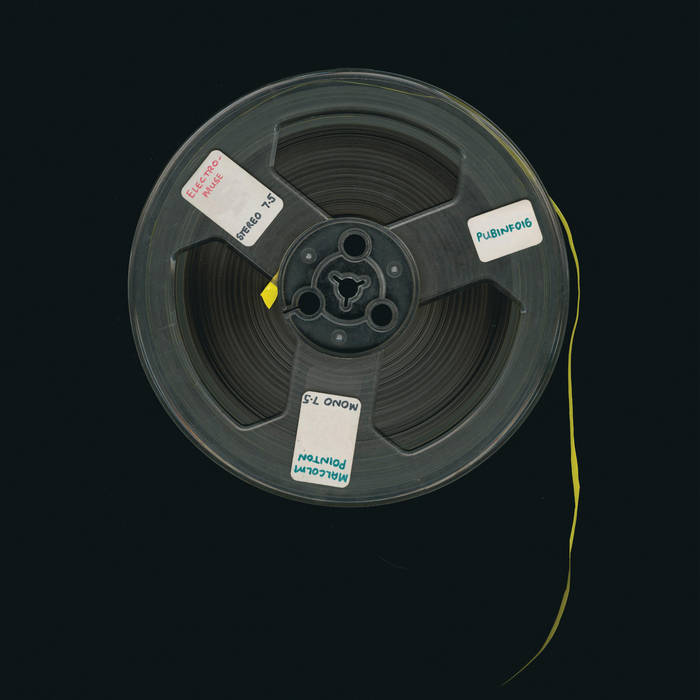
Swap Xenakis for the Malcolm Pointon comp, Electromuse, on Public Information - obvious similarities between the first track and Xenakis, although Pointon probably never stretched a creation to an hour in length. But it is a fine kind of noise and we have top UK vintage electronics archaeologist Ian Helliwell to thank along with Public Information. Pointon began his tape music voyage of discovery in 1969 having been inspired in part by Stockhausen. He had worked for the BBC, doing what, I don't know, but I wonder if it's coincidental that the same organisation should have spawned it's own school of tape music pioneers earlier in the 60s. Whatever, this is a great collection, not basement tape excavation for the sake of obscurity.  Then Wakes The Ice is as good a piece of tape trickery as I've heard, complete with chopped vocals that William Burroughs would have been proud of, play it all back...backwards too. As a bonus, in keeping with what is almost a tradition in these kinds of collections, we hear Malcolm introducing Symbiosis and describing the kit in a typically English 'BBC voice'. First class release.


Friday, 28 October 2016

Unruly Milk - Spilaggges

Image of Unruly Milk - Spilaggges - CD Album

Small is beautiful. 

Have you ever considered the irony of communally-minded folk only operating as singular entities due to necessity/economics etc and rightly promoting the notion of individuality whilst espousing communal values (in society at large) & supporting Left ideals of the communal society sharing wealth etc? Perhaps there is no irony. Can't the individualism of cultural resistance inhabit a broad socially networked common society of caring for each other and more to the point, those less well-off? Surely...

Politics. I didn't mean to start that way. Unruly Milk aren't Political. They're political? They'll tell you there's no 'point' to this. It isn't part of a master plan. It isn't made with an aim. It is was it is.

Small is beautiful - make a zine, a book, an album, art - why not? Because you want to and you can.

Spilaggges deserves to be global but everything that's Global stinks - your company, your coffee, your pop icons - all rotten to the core, all Gods to kneel before because you are barely worthy of existing on their planet, never mind benefiting from their power. Global business gods - all hail them! They give us jobs, after all. They run society for us in the name of business. They're looking after us. Nissan deal! That's a lot of jobs. We're all for hire so please do so. You just can't knock job-providers. Look at the middle-classes in my street, giving work to all those scaffolders and builders via gentrification - innit marvellous?! Working class people used to live here - so what?

And on...

Worship Pop gods for through their might thou shalt inherit greater strength in numbers and the power they exude which you, with open arms, will embrace. Crowds and Power. It's great to feel a part of something, isn't it? Not just anything, but a big thing, a Global thing. Unless we join the crowd we shall be crushed underfoot as they rush towards their gods. We'll be outcast, branded weirdos and condemned to suffer that fate commonly known as being 'different' which, you'll be surprised to learn, is still a possible state of existence even today when the 'different' are mass-marketed and, yes, made into a Global phenomenon.

How to be different. One old ploy was to dress like business men when everyone else in music was looking ragged, post-Punk or whatever. That worked, for two minutes. Today we can't do that because you'll just be taken for twats, plain ordinary twats aspiring to uber capitalist social status (by other 'outsiders', anyway). There's no alternative. Every tribe is full and by joining one you'll be just another number in that tribe. Be a skinhead. That would be different. Boots 'n' braces. Scare people. Make sure you wear an Anti-Nazi League badge, though, just to make the point that you're not one of them.

Micro-talent is Big, these days - brewers, bakers...and other makers. Some sell-out to big companies and make millions. Some bands used to start small and sell out. Remember Punk? But there are few big record labels today and none are looking for the Next Big Thing from 'the street' unless it's Street music like they're praying for a 'new' Hip-Hop/Grime whatever.  

So now people really do make music for themselves without actually dreaming/believing they might 'make it'. Like this grubby crew from England's West Country (not even London!) making music in a barn. I jest, playing the city sofisticate, but really, joking aside, Unruly Milk make me consider moving to Somerset. Why? Because there is a great little 'community' of music-makers who know each other, get together and at the end of it have a small-press CD to show for it. Whereas London (curse this city) crushes the idea of any such thing. Its enormity, its alienating gleaming glass towers of capitalism tower over everything and its poor must flee to find housing. If small collectives exist they do so in secret, lost in this money jungle to those who might seek them out. If Somerset (Unruly Milk's county) necessitates close-knit activity, London makes the idea redundant, an ideal of days gone by (community-wise). London challenges the idea of getting together. The very structure itself seems to taunt those who try. Or am I just too old and don't have the energy required?

If Global superstardom/business has power, so to do Unruly Milk. What they give the giants cannot. What Unruly Milk do is connect, instantly, the second you press 'play'. Remember when music was a precious thing? Even though it may have been provided by Global companies, you treasured it, not having the opportunity to say 'No' and opt for an indie alternative until Punk happened and we know how that went. I'm showing my age.

Unruly Milk is Joe Thompson from Hey Colossus / Henry Blacker, and Kek W (ex Ice Bird Spiral, Hacker Farm, etc) with help from Elisa Thompson and Stef Giaconne. Joe calls it The New Wave of Somerset Lo-Fi and I like to believe that's really going to be something. What is this thing anyway? I hesitate to use certain labels about Spilaggges, besides, I'd only make up stupid ones. They say of Jazz that you 'get it' or you don't (try convincing someone that Albert Ayler is worth their time). I feel the same about this music. I won't try to convince you that it's anything, not in the usual way. 

I can't say one song is amazing, one solo, one rhythm or technical (as in kit) wizardry makes it shine. But even the almost-nothingness of Found Anything Yet, Jake appeals to me, at under one minute of rummaging, crashing about, a simple tune on guitar accompanied by whistling and finally, the briefest female voice sighing something.

Nothing here is common, not the 'ambient' moods, possessing as they do something else, a texture in distortion, simple repetition but most of all that feeling of...what? Spontaneity? Perhaps. If it seems 'throwaway' to some that's because they know they cost of everything and the value of nothing. The old values ceased to be significant decades ago yet people still persist in upholding/worshipping them. You know, production values, skill, virtuosity, all of which we treasure in our personal preferences from music of old yet there's no place for them here. 

This, however, is not the hackneyed sound of 'nihilism' and destructive energy (that's been commodified). To use Ornette Coleman's album title, it's 'something else'. Even the song, Western Zoyland, crackles with Otherness, literally a distortion of the Pop song, or 'la-la' vocal whimsy of Folk. Ditto Ambassadeurs, the ruffness of the song barely breaking through the fuzz. The Woods Near Albi, with it's fluttering wings sample, makes a mockery of most Hauntological efforts, being truly atmospheric as opposed to pre-set Ghost Box mimmickry.

Join the 100 club and buy Spilaggges. In doing so you'll be part of the solution, not the problem.

Available from Blackcat Records


Thursday, 13 October 2016

Far From The Edge: Drum 'n' Bass LPs Revisited


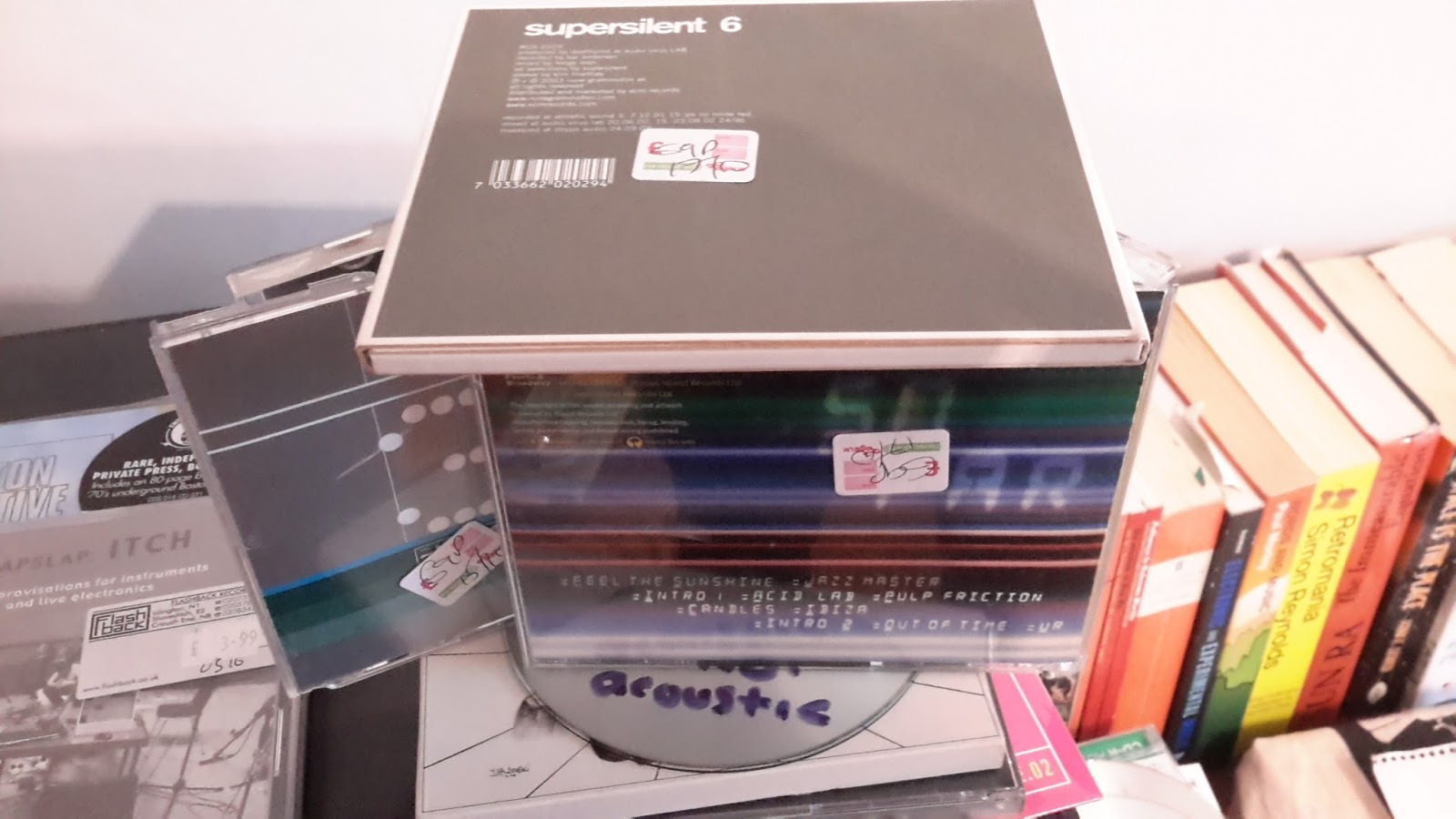
I passed on Hootie and The Blowfish (I must be mad!) but having found Supersilent 6 for 69p went back through the three racks of CDs in Help The Aged thinking I may strike a rich vein as donated by someone with taste. No luck. As it happens, no-one with Good Taste dumps the resulting books, CDs and films in a charity shop - very rarely anyway. Good Taste, as you know, isn't a 'matter of taste', it's a proven fact, the rules of which run along the lines of 'I have great taste and know what's brilliant and what's shit and anyone who disagrees with what I chose is wrong' - that's about it. For a larf, I also bought Alex Reece' So Far and Roni Size' New Forms, wondering what big breakthrough (sort of) D&B albums would sound like 20 years later - well, at 69p, not much to lose.

Neither Reece nor Size are new to me; I remember them first time 'round. I had New Forms but can't recall owning So Far. Listening now, perhaps I only had it for a few weeks before selling the thing, despite it being 'a masterpiece of spectacular alchemy' - The Guardian (so it says on the sticker) - er - well, we all got carried away about tunes at times but...I wonder if the journo who wrote that still feels the same? Any of us fools who write about music can allow the excitement felt upon first hearing something to tip us over into enthusiasm which, after a few months, never mind two decades, proves unfounded, or at least exaggerated.

You can't deny Pulp Friction, no matter how hard you might want to, but the rest of the album suffers from an awful polishing of the edges that made D&B great to my ears. OK, Bukem's sound was very smooth too and I don't play that stuff anymore either. So Far features a lot of female vocalising, which may explain why some mainstream journos took it seriously...because...it imitated 'soul'? They couldn't handle the hard stuff, the dynamic, experimental, raw sound, perhaps. Besides, most makers of classic 12s didn't get to the album stage and that's exactly what saved them, in hindsight. Making an album back then was still a feat lumbered with old Rock baggage of requiring sustainable 'quality' over the length of an album in order to gain credibility with mainstream hacks.  

The other standout track on So Far is Acid Lab, which has some bite, along with a good semi-jump-up b-line, but I'm snoozing through most of it and the local charity shop bag awaits...

Come on Roni, I know you can do better. It's a year later (1987), on Talkin' Loud and another Big Tune in the form of Brown Paper Bag, the impact of which I remember well, being behind the decks at the time and also on the 'floor when others played it - boom! - that acoustic b-line. Lots of rap/poetry here, but if the lyrics aren't exactly profound or clever, at least they provide more gravitas than just a woman crooning simplistic nonsense. There's usually some oomph in the rhythm too, although it's all very 'clean', with one eye on what 'quality' means in terms of an album. 'Live' drums and acoustic bass, along with good production, spark life into most tracks but to be honest the jury's out on New Forms. The alternate 'funk' pace of Watching Windows catches my ear, though. At least Size had the nerve to break the mould occasionally.

Having listened to these albums they mostly make me yearn to hear more renegade snares and off-kilter breaks from those who never made long-players. Perhaps what I really mean is that by going for 'serious LP' status and considering the time period, D&B was losing it's soul. That's the dirty street variety as opposed to the vocal kind. Not that Size went penthouse sell-out, I know. The mid-90s alternative to striving for lush achievement was Tech Step, D&B's last hurrah and a nasty, hard nail in the coffin it proved to be, thankfully. It was as if the sound had returned to it's Dark Rave roots, wherein it could only disappear, dragged into the vortex of its own making.


Tuesday, 4 October 2016

Vinyl, Webern & Cecil Taylor


Putting a record on...once an ancient pastime but one that's no longer the sole preserve of us older generations thanks to the vinyl revival. I hear people also buy records and never play them, preferring the MP3, which seems perverse but does demonstrate the allure of the old format and I'm not knocking anyone who does it. Let he who is without sin cast the first stone. I've bought albums before and only played them once or twice but listened to the file many times. We're all aware of the advantages; the ease of skipping tracks and...that's just about the only one I can think of, unless the speakers hooked up to your computer are better than those with the hi-fi.

One advantage with vinyl is that it creates sound away from this screen. The issue most of us have is screen addiction, to the point where all life emanates from them, large or small. So the simple feat of creating another source of entertainment, from another place, feels like a significant change, a break from total slavery to the machine. The sound is also better, a fact that has little to do with vinyl's superiority over digital but simply the weight delivered by my trusty old Wharfedale speakers, which do just as good a job if I'm playing CDs.

I've never been keenly attuned to sound quality variations, unlike those who wage war over the issue whilst no-one appears victorious. As a sound technician once said, vinyl won't sound 'better' if your equipment is not up to scratch. Scratches of another kind are also part of vinyl's appeal to some. I understand the nostalgia of well-worn vinyl, having spent a few years listening to reggae singles played in The Elephant's Head, Camden, their grooves seemed to carry in them the very essence of time, history and for some of us, memory. 

Dirt on one side of the Webern box pictured above stopped the needle in its tracks twice. This was remedied by finding the grime and holding my fingernail over it as the record spun. I now have very old dirt under my nail and should really give it a scrub, but since I'm already infected with a virus, it hardly seems worth worrying about.

The dirt, grime, dust, smears, fingerprints, creases and tears of the old music carriers are also pleasing to me. I can't help but ponder the history of the Webern box, where it's been since 1978...how many homes? Perhaps only one. Did the owner die, or simply change over to CDs? How did it end up in the Kentish Town charity shop? Webern's history regarding the Hitler regime is not a noble one. As cited in Alex Ross' The Rest Is Noise, when Germany invaded Norway and Denmark he declared:  'Each day becomes more exciting. I see such a good future.'  Well, it is anyone's right to refuse the music of the politically suspect, but I choose not to do so.


On the subject of sound in various forms Cecil Taylor, in the 1965 Downbeat interview used as sleeve notes for this album, suggested that the way 'high fidelity is used falsifies by compensating for the weaker musicians'. He said this whilst discussing pianist Bill Evans and bassist Scott LaFaro whose playing, he believed, was enhanced, or 'falsified', by recording techniques. Ouch. So accusations that weak artists are compensated for by studio engineering are nothing new. The difference being that Taylor was taking a swipe at extremely accomplished musicians rather than the industry-built boy bands or naturally incompetent singers of today.

If not exactly generous in spirit, Taylor's music just keeps on giving and Nefertiti, the Beautiful One Has Come remains one of my favourite albums, not least because it is an album, double vinyl from 1976. It's very material existence means something though what, exactly, I'm not sure. But every time I pull it from the shelf I feel the kind of satisfaction merely clicking a mouse cannot compete with. It's as if the actual cardboard and vinyl render it...sacred? As an artifact? It's not rare or expensive to buy. No, the otherness of vinyl in the age when I play far more files than records perfectly mirrors the otherness of the music...this rampant, spider-scuttling-over-the-keys, squiggly, contorted Bop in free form...a Jazz branch cut loose to fall where it will and grow into something else, in this case, Cecil Taylor music, a one man genre.    

Here is one of the record centres. That tear could represent the great rip in Jazz around 1960...as if the obliterated print is history although, conversely, the readable part may be history, the definite, clearly definable, whilst the white space is freedom...the imaginary, imaginable universe of sound opened up by the likes of Ornette Coleman and Cecil Taylor in their own ways.


Anton Webern was, as you probably know, a disciple of Schoenberg, therefore a revolutionary composer in his time. In his and Taylor's recordings we hear new possibilities for music, from the studied, intellectual 'freedom' of early-20th century atonality to the open-ended joy of piano keys as a canvas for countless points of colour/sound.  
   

Wednesday, 20 July 2016

Punk: periodical collection


Edited by Paul Gangloff, featuring discussions with Stephan Dillemuth, Martijn Haas, Dominique Hurth, Eleonor Jonker, Gee Vaucher and others on zine-making, distribution and the ethos behind them. Very good book this, with some superb images made especially for the project.


'Stephan Dillemuth: One thing I think is important about these publications is that they serve a certain purpose, there’s a need to make them and there is a certain context for that need – that’s important. A lot of publications today are not made anymore out of need, but just to make money with advertising and for that they need “content providers”, that’s what writers and artists became. Service industry serves the manufacturing of redundant information, in order to generate revenue with advertising. There is no other inner need, no inner drive, no other purpose behind it and that’s also visible in the design, no simplicity, no directness, just packaging and hollow inside.'


Visit any zine fair today and you'll see a lot of material that's all 'packaging and hollow inside', despite being personal and handmade rather than to 'generate revenue with advertising'. For some, small press is on a par with cake-making and other crafts, hence it's popularity. The political or cutting-edge art aesthetic is largely missing. It's as if makers long for the old ways (of production) in this age of technology, but use them to create little more than pretty, vacuous product. 

The obvious difference today is that the overriding spirit of the era from the 70s to mid-90s is absent. The politics of living then (on the dole, protest, rebellion), fuelled in part by music was of it's time. Today, 'protest' or artistic rebellion is more likely to take the form of memes that clog your Facebook wall...oh, and those petitions. And Tweets, of course. Hardly substitutes for hand-crafted images and stapled pages which you can hold and feel in more ways than the purely physical. Punk: periodical collection is freely available in PDF form, but having the book is better. Read more and buy it here

Wednesday, 22 June 2016

STALAG GLASTO MMXVI by Simon Elmer


With his permission, of course...

Collage by Simon Elmer

The Pyramid Stage, which is the setting for the highest unit-selling acts, is a raised platform some 40 metres square and maybe 10 metres from the ground. Below this stretches a sort of no-man’s land approximately 20 meters wide that ends with a high metal fence through which the foremost ranks of the audience peer. In front of this fence, and watching the crowd, is stationed a line of 30 or 40 uniformed security guards, who stand almost elbow to elbow. The crowd beyond, which numbers in the tens of thousands, goes back several hundred meters. Beyond the first 20 metres or so, however, the entertainers on stage are reduced to mere stick figures.

To compensate for this, large screens almost as big as the stage itself are positioned either side, where the acts are shown in close-up. Despite their physical presence at the festival, it is at this virtual image that nearly all the assembled viewers stare – not to see the performing act, which is mere background, but for the rare chance of finding themselves captured by the numerous cameras, and of seeing themselves, however briefly, projected on the same screen that they are staring at. To this objective, the audience dresses in bright and colourful outfits, the most photogenic girls perched on the shoulders of the most photogenic men, waving large flags that block out the view of anyone trapped behind them. Everything is geared towards catching the eye of the cameras and the millions watching, as the commentators assure us, ‘at home’. At these felicitous moments, which draw cheers more rapturous than any reserved for the nominal acts on stage, the cycle of reciprocal stares completes the logic of the spectacle.

The ground on which this vast crowd stands, which is known as the ‘Arena’, is the churned-up mud of a field on which cows graze for the remainder of the year. Because of this, members of the crowd must wear some form of rubber boots, which they bring with them, spending large amounts of money to buy the latest, most fashionable, most expensive brand. Like the watch of a rich undressed man lying on a beach, the rubber boot is the sign of class status in the society of Glastonbury Festival.

Between the raised stage and the metal fence is a flight of stairs, a ramp and more stairs, down and along which the brand-identity-member of each performing band may walk into the no-man’s area. Here, protected by additional security guards who stand behind the first rank and are retained for this purpose, the band’s brand-identity-member may receive what tokens of adoration his followers wish to offer him or her through the bars of the fence. This is known as ‘crowd interaction’, and has come to be an almost obligatory moment in the performing band’s set. Sometimes, if these offerings please him, the brand-identifier will bring them back onto the stage and display them to the crowd beyond, who view this intimate interaction with their idols through the images projected on the huge side screens.

Despite its high security setting, which re-enforces the existing physical, social and financial relation between the performance commodity and the paying customer, the Pyramid Stage is the site of enormous happiness, ecstatic outpourings and feelings of community, for which the attending congregation pay large, and sometimes enormous, sums of their own money, endure considerable deprivation and hardship, and even sleep in plastic tents, whatever the weather, in the designated encampments that surround the main compound. The entire camp, which last year held 200,000 people, covers 1000 acres of land, and for the 5 days of its annual existence is the 7th most populous city in the South of England.

Like the 2012 Olympic village, Glastonbury Festival is at the forefront of the transportation, accommodation and manipulation of the consuming masses that constitute the contemporary human conglomeration (the old distinctions between urban, suburban and rural no longer applying) to the demands of the spectacle through which they are brought within shopping distance of the commodity. Both are a sort of concentration camp of consumption (as opposed to those of production, which are largely outside the restrictive employment practices of Europe) overseen by multinational corporations. The fact these camps are willingly entered – even paid for by the consumers of their spectacle – makes them no less of a camp. And like all post-war experiments in social manipulation, control and indoctrination, the model for Glastonbury Festival is Auschwitz, which itself has been transformed into a tourist attraction equally willingly entered and paid for by the masses in search of authentic experience. The Arena is our gas chamber, the Pyramid Stage our crematoria, and Glastonbury, the perpetual festival of consumption, is the Nuremberg Rallies of our era.
On the outskirts and borders of the Glastonbury camp is a mass of secondary consumer outlets selling every kind of commodity-experience, from spiritual enlightenment to spiritual healing to spiritual communion (all, however, are purchased with material currency). In an imminent critique of the festival’s own mass commercialisation, these are advertised as the ‘real’ Glastonbury Festival. Like every outlet of mass consumption, Glastonbury has co-opted the economy of the market stall: it lends street credibility to jaded consumers in search of the authentic. But in the end they all go inside and line up at the tills. Even the Nuremberg Rallies had stalls selling dolls dressed in lederhosen and bands playing German folk songs. Nostalgia for the authenticity of a distant past is one of the selling points of the mass-manufactured commodity and the New World Order we have bought into. Glastonbury, which like Nuremberg is the site of a mystical (that is, lost) communal identity, complete with its own mythical site of pilgrimage in Glastonbury Tor, is perhaps the greatest conjurer of this illusion for the consumer-subjects of monopoly capitalism.

Friday, 29 April 2016

Digital Art / The CD Revival / Beyonce vs Aretha /


Meet Me At The Morgue (detail) full picture here

***

Q: What's the point of blogging?
A: I dunno

***

The CD Revival....


                                                                            ...a friend came 'round the other day and we chatted about music buying, him saying he still preferred CDs, me thinking 'Ah, yes, a child of the 80s' whilst feeling all modern with my choice of MP3s. Then, as I was compiling my 10 Essential Jazz Albums, listening to Thelonious Monk on YouTube, fucking adverts came on after every track. Now, I could set about trying to download Monk but instead it struck me that I really should get more of him on CD. We know the sound's better. So I did; a cheap box set containing 9 albums. That's better. Although ideally I'd rather have the individual albums I think more of space-saving, these days. In Fopp the poster proudly proclaimed: 'Vinyl Is Killing MP3s' - well how about 'CDs Are Killing Vinyl'? I love vinyl, of course, but was reminded of its failings by a hi-fi buff at a party last year who said he was totally digital now. I'm not about to go on about that particular subject. Enough's been said. 

***

Q: What's the point of Beyonce?
A: I dunno


                                                                             ...she annoys me. Am I the only person on the planet to feel that way? The Guardian has been promoting her like she's the new Aretha Franklin-meets-Marvin Gaye circa What's Going On meets-Stevie Wonder...such genius! Bollocks. I watched some of a new video. She dances in it - you know - that sort of choreographed shit, but here I must bite my tongue instead of making derogatory comments about her 'ass' although...it seems to be a feature she's keen to promote. Mostly it's the posturing I can't stand...those faux 'street' gestures, the high gloss 'attitude'...and as loath as I am to come on like an fart enamoured only with old music, if you watch Aretha performing in her heyday...


...I rest my case. I only put the case because having heard a fair bit of music context is inescapable, history is inescapable, for those of us belonging to a certain generation. We can't help but make comparisons. Sometimes I even pity those young YouTube commentators who, regarding a classic piece of reggae, Funk, Punk or whatever, say things like 'Music's shit today, I wish I'd been around in those days'. I was. It's some consolation for the ageing process...

Related Posts Plugin for WordPress, Blogger...