From the 40s, 50s and 60s. What exactly were the 'Strange Little People'? I'd love to have seen the 'Barracuda Ape', and the 'Cyclops Pig'. Conjoined twins as freak show exhibits seems a cruel concept, although despite thinking we're all more sensitive now we can't deny a curious streak regarding 'freaks'. Reality TV programmes still feed that curiosity. TV and the tabloids are awash with modern freaks, most of whom disfigure themselves freely in the name of 'improving' their appearance courtesy of the surgeon's knife.
For those in the no...
Showing posts with label Film Noir. Show all posts
Saturday, 30 March 2013
Wednesday, 7 September 2011
One Lonely Night - Mickey Spillane
Something I picked up the other day. Spillane wrote his first novel, ‘I, The Jury’(1947), in nineteen days. It sold six-and-a-half million copies (hardcover and paperback). By 1980 he’d written 7 of the top 15 all-time best-selling novels in the U.S. Even his stats are hardboiled. The writer as literary gangster, smashing his way into the writing racket and ruling it, spitting out words likes bullets from a .50 BMG – 450pm, drilling holes in critics, slugging members of the Shakespeare Squad – he made Papa H look like P.G. Wodehouse. I know a guy who’s only read one novel, and that was ‘My Gun Is Quick’. The nemesis of liberals, no time for depth of character, subtle nuances, or the niceties of political reason, he was an atomic author, a wham-bam wordsmith – the all-American way – get rich quick and to hell with everyone, especially the critics.
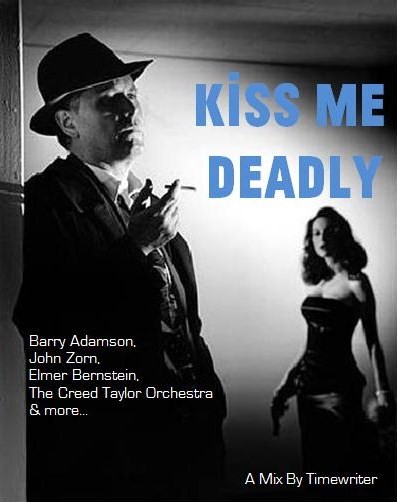
My 'Kiss Me Deadly' mix is now available as a download.
Wednesday, 24 August 2011
Kiss Me Deadly - A New Mix
In case you hadn't noticed, I've created a new mix on Soundcloud, see the bar on the right. Inspired by Film Noir, as you may guess by the flyer and title. I've tried to create a suitably dark mood by combining ambient sounds with Jazz and sampled dialogue.
Monday, 13 June 2011
Grimoire - Kreng (Miasmah)
Pepijn Caudron’s second album for Miasmah cracks your skull wide open and casts a spell, especially if you listen with plugs in – a spell so devilishly seductive, so dark, it makes Demdike Stare sound like...Pop – yes, it’s that good. If Pop Sounds and Happy Music in general are godly gifts to lift the hearts of listeners, this extraordinary album is the work of the anti-Christ, and as you know, the Devil has all the best tunes. Not to suggest that Pepijn is a wicked person (I’m sure he’s a nice fellow), but that this record absolutely represents the very best in sinister, mysterious modes of music-making, without resorting to brutalism, ie Noise. There is a remarkable passage in the 9-minute ‘Wrak’, however, in which a skronking sax and electronic maelstrom combine to blow your brain. It’s all the more effective for being sandwiched between plaintive piano, and strings reminiscent of Herrmann’s work for Hitch. ‘Ballet Van de Bloedhoeren’ demonstrates another side of the multi-faceted Caudron in a beautifully melancholic chamber (of horrors) quartet mode made more grisly by a low-end electronic undertow. ‘Satyriasis’ is one of the most intriguing pieces, a subtle exercise in creeping horror sketched out by jazzy brushwork, strings, piano and restrained electro-ambience. This is not an album you can skip through and hope to understand what’s going on, so don’t bother. It demands, and requires close attention because, as in all great horror or Film Noir flicks, the substance and true meaning lurks deep in the shadows. Amazing work.
Tuesday, 26 April 2011
Angel Face (1952)
Thursday, 24 February 2011
The Death Of The Old Film Critic and Rise Of The New
The old guard of films critics have been made redundant - long live the new democratic order! All opinions are valid! Suck on this Philip French!
Yes, I speak as one of the three trillion bloggers who, like so many termites, have gnawed at the foundations of the House of Professional Criticism and now rejoice in its collapse.
I doubt that directors care. Marty isn’t listening to me, or any other blogger. Unless one day when he’s really bored he Googles ‘Taxi Driver’, clicks through 53 pages and arrives at my opinion of his masterpiece. Perhaps 53 is a little optimistic since I doubt that IMO is that high on search engine hit parade.
Now that the barbarians have stormed the city they bring with them the sweet perfume of popcorn, and stain the floor with spilt Coke. They jam the empty bucket-sized carton over the head of the Pauline Kael statue and floss their teeth with a reel of film containing ‘The Bicycle Thief’ – hah! David Thomson walks by and they chant football fan style ‘Who are yer?! ‘Who are yer?!’ C and K aren’t the initials of The Greatest Film Of All Time, they’re the brand of your pants and perfume.
But hold on, do I talk of ‘them’ or ‘we’? Am I really part of the new order, or longing to belong to The Dead Critics Society? I’m neither, actually. That’s me, somewhere else, which is where I’ve always resided. I’m quite comfortable here, although it does have setbacks, and one of them is not belonging. Well, to hell with it.
I like the fact that over the decades there have been lists of films made up by The Critics which, when combined, give us, say, 50 agreed-upon Classics. Without them I would not have discovered many great films and may have wasted a lot of time watching rubbish. Guidance is a good thing. Yes. And now Everyone is a guide, a critic. So, imagine a youngster with little viewing experience coming across an Amazon list, or a blog, extolling the virtues of ‘Pretty Woman’. Yes, he or she is off on the wrong track for starters. But, you may say, suppose they love ‘Pretty Woman?’. Well then, they get what they want and deserve. And they are lost forever. I recently came across some poor sap who actually went to see ‘Get Him To The Greek’ because it averages a 7-star rating on IMDb. He gave it one star. Can you imagine being so clueless as to use the opinions of those people as a guide?
Don’t tell me ‘It’s all a matter of taste’. It is, but since when did you think that people packing cinemas to watch the latest blockbuster/crime/Rom Com crud were behaving wisely? Admit it, you have your own inner snob which calls them ‘wankers’ whilst the liberal, tolerant you happily allows other people to wallow in shit because you like to think you’re not a cultural fascist.
Regarding this matter of Taste, there has to be the will to appreciate the finer things in life. Where that comes from I’ve no idea. Your parents, peers, or an inspirational teacher, perhaps (I’ve heard they exist, but never met one when I was shackled to a desk). Yet the sad fact remains, dear reader, that many will insist on believing ‘Four Weddings’ to be an All-Time Classic. The same people who buy McFly tracks, presumably. And today, if you’re not careful with the mouse, you’ll come across fan sites for Hugh Grant. It’s a dangerous world, this digital domain. You can stray into some awful places that will taint your view of humanity.
But where does the rise of the New Democratic Order leave the Old Classics? Do they rot alongside their supporters, The Critics? Because this is about more than simply Everyone expressing their opinion here in Blogsville; it’s about the values the old guard treasured. They used such old-fashioned criteria as the standard of visual artistry, the literary merits of a script, acting, directing etc. And they could place a work in its historical, socio-political and cinematic context, of course, because they were clever, about film at least. And they knew, of course, that The People do not give a hoot about ‘The Bicycle Thief’ and Italian Realism, or the mise-en-scene, or any other fancy concepts (most haven’t grasped what ‘film noir’ is - the idiots!).
Once those values become completely redundant, the sluice gates are opened and all that ‘art’ is washed away. That generation, the so-called baby-boomers, will be gone one day, and who will shape or influence opinion then? Who will guide the ignorant towards the heights of Great Cinema? ‘Avatar’ and ‘Titanic’ fans, probably. To some extent, they already do. It will be a sorry world then in which the remaining few with anything like discerning taste will be locked away in their little rooms, forming a weird cult which communicates in code via the internet whilst praying they don’t get caught and prosecuted for downloading stills from ‘8 1/2’. It could happen.
Since I don’t believe in either/or scenarios I’m not advocating slavish adherence to the Old Critic’s list of Essential Cinema, god knows that would be dull and represent a sacrificing of all that makes us what we are as individuals. But, to throw it out in gleeful celebration of The Self Against Classicism seems to me to be just as bad. If your Self is anything like mine in this respect it can be a lazy bastard that likes nothing better than to be entertained without using a brain cell. That’s OK sometimes too, but the great, complex, deep and, dare I say, more profound things in culture (and life?) tend not to come so easily. Yes, a little, sometimes a lot, of effort is required.
Primitive man didn’t face this conundrum, and if we hadn’t created what we call culture today, neither would we (never let it be said that this blog is not educational). Mind you, when you watch ‘One Million Years BC’ you see that he did have to contend with dinosaurs. Other than that he was content to fuck and forage for food. And travel, probably. That is the total extent of my anthropological knowledge right there. And yet, if we look around, like Attenborough creeping through the urban jungle, perhaps we may still see this man (and woman)...ssshhh...there...in the dark...transfixed by images on the screen...watching ‘Get Him To The Greek’...
Sight & Sound Poll 1992
1) Citizen Kane Orson Welles, 1941 (43 votes) US
2) The Rules of the Game Jean Renoir, 1939 (32) FR
3) Tokyo Story Yasujiro Ozu, 1953 (22) JP
4) Vertigo Alfred Hitchcock, 1958 (18) US
5) The Searchers John Ford, 1956 (17) US
6) L'Atalante Jean Vigo, 1934 (15) FR
7) The Passion of Joan of Arc Carl Theodor Dreyer, 1928 (15) FR
8) Pather Panchali Satyajit Ray, 1955 (15) IN
9) Battleship Potemkin Sergei Eisenstein, 1925 (15) USSR
10) 2001: A Space Odyssey Stanley Kubrick, 1968 (14) UK
Yes, I speak as one of the three trillion bloggers who, like so many termites, have gnawed at the foundations of the House of Professional Criticism and now rejoice in its collapse.
I doubt that directors care. Marty isn’t listening to me, or any other blogger. Unless one day when he’s really bored he Googles ‘Taxi Driver’, clicks through 53 pages and arrives at my opinion of his masterpiece. Perhaps 53 is a little optimistic since I doubt that IMO is that high on search engine hit parade.
Now that the barbarians have stormed the city they bring with them the sweet perfume of popcorn, and stain the floor with spilt Coke. They jam the empty bucket-sized carton over the head of the Pauline Kael statue and floss their teeth with a reel of film containing ‘The Bicycle Thief’ – hah! David Thomson walks by and they chant football fan style ‘Who are yer?! ‘Who are yer?!’ C and K aren’t the initials of The Greatest Film Of All Time, they’re the brand of your pants and perfume.
But hold on, do I talk of ‘them’ or ‘we’? Am I really part of the new order, or longing to belong to The Dead Critics Society? I’m neither, actually. That’s me, somewhere else, which is where I’ve always resided. I’m quite comfortable here, although it does have setbacks, and one of them is not belonging. Well, to hell with it.
I like the fact that over the decades there have been lists of films made up by The Critics which, when combined, give us, say, 50 agreed-upon Classics. Without them I would not have discovered many great films and may have wasted a lot of time watching rubbish. Guidance is a good thing. Yes. And now Everyone is a guide, a critic. So, imagine a youngster with little viewing experience coming across an Amazon list, or a blog, extolling the virtues of ‘Pretty Woman’. Yes, he or she is off on the wrong track for starters. But, you may say, suppose they love ‘Pretty Woman?’. Well then, they get what they want and deserve. And they are lost forever. I recently came across some poor sap who actually went to see ‘Get Him To The Greek’ because it averages a 7-star rating on IMDb. He gave it one star. Can you imagine being so clueless as to use the opinions of those people as a guide?
Don’t tell me ‘It’s all a matter of taste’. It is, but since when did you think that people packing cinemas to watch the latest blockbuster/crime/Rom Com crud were behaving wisely? Admit it, you have your own inner snob which calls them ‘wankers’ whilst the liberal, tolerant you happily allows other people to wallow in shit because you like to think you’re not a cultural fascist.
Regarding this matter of Taste, there has to be the will to appreciate the finer things in life. Where that comes from I’ve no idea. Your parents, peers, or an inspirational teacher, perhaps (I’ve heard they exist, but never met one when I was shackled to a desk). Yet the sad fact remains, dear reader, that many will insist on believing ‘Four Weddings’ to be an All-Time Classic. The same people who buy McFly tracks, presumably. And today, if you’re not careful with the mouse, you’ll come across fan sites for Hugh Grant. It’s a dangerous world, this digital domain. You can stray into some awful places that will taint your view of humanity.
But where does the rise of the New Democratic Order leave the Old Classics? Do they rot alongside their supporters, The Critics? Because this is about more than simply Everyone expressing their opinion here in Blogsville; it’s about the values the old guard treasured. They used such old-fashioned criteria as the standard of visual artistry, the literary merits of a script, acting, directing etc. And they could place a work in its historical, socio-political and cinematic context, of course, because they were clever, about film at least. And they knew, of course, that The People do not give a hoot about ‘The Bicycle Thief’ and Italian Realism, or the mise-en-scene, or any other fancy concepts (most haven’t grasped what ‘film noir’ is - the idiots!).
Once those values become completely redundant, the sluice gates are opened and all that ‘art’ is washed away. That generation, the so-called baby-boomers, will be gone one day, and who will shape or influence opinion then? Who will guide the ignorant towards the heights of Great Cinema? ‘Avatar’ and ‘Titanic’ fans, probably. To some extent, they already do. It will be a sorry world then in which the remaining few with anything like discerning taste will be locked away in their little rooms, forming a weird cult which communicates in code via the internet whilst praying they don’t get caught and prosecuted for downloading stills from ‘8 1/2’. It could happen.
Since I don’t believe in either/or scenarios I’m not advocating slavish adherence to the Old Critic’s list of Essential Cinema, god knows that would be dull and represent a sacrificing of all that makes us what we are as individuals. But, to throw it out in gleeful celebration of The Self Against Classicism seems to me to be just as bad. If your Self is anything like mine in this respect it can be a lazy bastard that likes nothing better than to be entertained without using a brain cell. That’s OK sometimes too, but the great, complex, deep and, dare I say, more profound things in culture (and life?) tend not to come so easily. Yes, a little, sometimes a lot, of effort is required.
Primitive man didn’t face this conundrum, and if we hadn’t created what we call culture today, neither would we (never let it be said that this blog is not educational). Mind you, when you watch ‘One Million Years BC’ you see that he did have to contend with dinosaurs. Other than that he was content to fuck and forage for food. And travel, probably. That is the total extent of my anthropological knowledge right there. And yet, if we look around, like Attenborough creeping through the urban jungle, perhaps we may still see this man (and woman)...ssshhh...there...in the dark...transfixed by images on the screen...watching ‘Get Him To The Greek’...
Sight & Sound Poll 1992
1) Citizen Kane Orson Welles, 1941 (43 votes) US
2) The Rules of the Game Jean Renoir, 1939 (32) FR
3) Tokyo Story Yasujiro Ozu, 1953 (22) JP
4) Vertigo Alfred Hitchcock, 1958 (18) US
5) The Searchers John Ford, 1956 (17) US
6) L'Atalante Jean Vigo, 1934 (15) FR
7) The Passion of Joan of Arc Carl Theodor Dreyer, 1928 (15) FR
8) Pather Panchali Satyajit Ray, 1955 (15) IN
9) Battleship Potemkin Sergei Eisenstein, 1925 (15) USSR
10) 2001: A Space Odyssey Stanley Kubrick, 1968 (14) UK
Monday, 4 October 2010
The Killer Inside Me & The Killers
Winterbottom, like Affleck’s bad cop, pulls no punches in ‘The Killer Inside Me’. Look how nasty violence can be, he tells us, as another sickening thud accompanies one more knuckle sandwich delivered by the killer. Thanks, Michael, I never knew how bad it was until you showed me. What he really showed me was that you can have too much of a bad thing and that directors shackled by censorship were forced to come up with more imaginative ways to depict what happens, to the benefit of the audience, surely.
Perhaps Winterbottom felt that he was filming for the really stupid and desensitised, in which case, thanks again, for patronising me. What kind of oaf needs a lesson of that kind? The popcorn-munching, Coke-guzzling teenager? Maybe.
Affleck’s got the look to play a stone-cold killer, but if I’d been watching this at the cinema I think I’d have begun to feel as sore around the backside as his victims. I got bored halfway through, thinking of what the Coen brothers could have done with it. But they’ve already mastered noir and the American Western psycho.
Here the cop’s internal monologue is supposed to go some way to addressing the problem of translating Thompson’s masterful prose into the visual, but it fails. Thompson’s classic was brutal, but bereft of the writer’s ability to be inside this killer, Winterbottom leaves us with a cipher for evil rather than a real character. Most unbelievable of all were the lovers so devoted to this man. Here, if we give any thought to it, their fondness for him is not justified other than in some slurpy love scenes and shots of Affleck smiling in their company. This killer must have had a lot of charm, charisma...something. Instead, he’s all inside out and we don’t see what they’re supposed to therefore the relationship’s make no sense. Is the fact that he likes to play piano and listen to classical music supposed to reveal the sensitive side? Read the book instead.
Hemingway’s ‘The Killers’ was first adapted by Robert Siodmak to create a classic noir in ‘46, then Don Siegel got a shot at it in 64, supposedly for TV, but it was deemed too violent so it got a theatrical release. Too violent then is nothing compared to today’s standards, of course. It’s most famous, perhaps, for Ronald Reagan slapping Angie Dickinson, not just because in retrospect it appears incongruous, but because it’s a slap that carries a lot of impact. Michael, less can be more. Winterbottom could have learned something from Siegel’s handling of the scene in which the killers deal with the blind female receptionist. Here, the depiction of evil behaviour is not lessened by the absence of graphic detail. Yes, we have to use that old-fashioned facility called imagination.
Dickenson’s femme fatale, exposed in the glaring light of day and full colour, is no less alluring than her noir predecessors, of course. If anything, her radiance heightens the contrast of what lies in her dark heart. Lee Marvin can always convey the killer superbly, without having to actually do anything. And watching Reagan play the bad guy is fascinating in itself. His woodenness seems to be an advantage as a ruthless criminal. The best shot comes towards the end, when Strom (Marvin) gets out of his car. All we see is the ground, shoes, then blood dripping onto the pavement. At times it looks like a TV film, but Lee and Angie make it very watchable, and Siegel is no slouch when it comes to direction crime films. Cassavetes is good enough as the desperate speed freak, but he should have known something was wrong when someone as beautiful as Angie plays the driver groupie. He wasn’t the one taking her for a ride.
Friday, 3 September 2010
Noir - Robert Coover
Writing mostly in the 2nd person (‘You lean up against a rough wall, light up a fag..’) Coover succeeded here in putting me in the same shoes as his private eye, by which I mean I got completely lost and staggered from page to page, dazed and confused from about the halfway point. With the kind of perseverance required by all good gumshoes though I stayed on the case, simply because the prose is so stylishly good. In that respect, this is as much a homage to Chandler as it is to the iconography of film noir. This is most obvious by the nerve displayed in calling his PI Philip M. Noir. As a testament to the skill with which Coover rattles of the poetic pulp prose, he gets away with that. ‘You’ being the central character helps, of course.
Chandler famously pleaded ignorance when asked who was responsible for a murder when Howards Hawks was filming The Big Sleep, and like good old Raymond, I too shrugged off plot details as I kept on walking down Coover’s hallucinogenic mean streets.
‘Everybody’s on that train. Nobody’s an original. To be obsessed is to be a wound-up actor in a conventional melo, with everyone else, the lucky ones, bit players at best. So it’s not the story you’re trapped in, like everyone else, but, once aware of that, how you play it out. Your style. Class. The moves you make.’
Coover could be commenting on the dilemma facing any contemporary author trying to rewrite the golden age of detective fiction in the post-modern era. He places every chip on Style and wins, for me. He’s great at doing what the best crime writers did, which is capture the moody city at night and the presence, the character of the streets and the metropolis. It isn’t set in a particular time or place, which heightens the whole dream-like aspect of the book. How much of this is dream, how much memory? Time slips...in such a way as to recall Philip K Dick as much as Philip Marlowe.
The book is as much a puzzle to me as the case Noir is trying to solve. How much of this is down to my failings or Coover’s skill I don’t know. Anyway, I’ll be reading it again because as far as I’m concerned, The Case of the Vanishing Black Widow is not closed.
Chandler famously pleaded ignorance when asked who was responsible for a murder when Howards Hawks was filming The Big Sleep, and like good old Raymond, I too shrugged off plot details as I kept on walking down Coover’s hallucinogenic mean streets.
‘Everybody’s on that train. Nobody’s an original. To be obsessed is to be a wound-up actor in a conventional melo, with everyone else, the lucky ones, bit players at best. So it’s not the story you’re trapped in, like everyone else, but, once aware of that, how you play it out. Your style. Class. The moves you make.’
Coover could be commenting on the dilemma facing any contemporary author trying to rewrite the golden age of detective fiction in the post-modern era. He places every chip on Style and wins, for me. He’s great at doing what the best crime writers did, which is capture the moody city at night and the presence, the character of the streets and the metropolis. It isn’t set in a particular time or place, which heightens the whole dream-like aspect of the book. How much of this is dream, how much memory? Time slips...in such a way as to recall Philip K Dick as much as Philip Marlowe.
The book is as much a puzzle to me as the case Noir is trying to solve. How much of this is down to my failings or Coover’s skill I don’t know. Anyway, I’ll be reading it again because as far as I’m concerned, The Case of the Vanishing Black Widow is not closed.
Thursday, 24 June 2010
Le Cercle Rouge
I’ve been thinking about Jean-Pierre Melville since watching ‘Le Cercle Rouge’ at the week-end. Is he that great? Is the film really a masterpiece? I only wonder because a lot of people believe both and I’m open to the idea but not fully convinced. Oh, I love the style of ‘Le Samourai’ but part of me thinks that’s its sole asset. My main memory of it is Delon being tailed...for what seemed like an age. I would have told JPM to edit that...though I don’t suppose he would have paid any attention. ‘Le Cercle Rouge’ is eminently watchable, not only because Delon is probably the handsomest man in the world (even with a ‘tache) but because it looks so good in those cool muted colour tones.
There are odd things, though, like the brilliantly surreal invasion of the marksman’s room by various crawling beasts, which I expected to have some significance later, but it didn’t. There’s no explanation of it, so I presumed he’d been a junky or something. He’s a mess who suddenly cleans himself up when hired for the robbery. I thought, at the crucial moment, he would start seeing iguana’s scampering across the floor of the shop. I mean, that’s what I would have written into the film, you know, to create some tension...will he hold his nerve? Or crack up and miss?
You see, I really could have made Melville’s films so much better than he did...apart from ‘Bob le Flambeur’, which is all-round great...and ‘Le Doulos’...which is hard to improve.
There’s also the mystery (to me) of the detective’s cats. Twice we’re shown him feeding them when he enters his apartment. Why? How is that scene necessary? How does it move the story along or illustrate the character? Film students: discuss.
I read somewhere that the film’s been butchered for release but I can’t believe it was cut to the point of rendering Corey’s relationship with the mystery woman (only seen hiding in the room of a man who owed him money) meaningless – what was all that about? There’s also a strange edit when Corey shoots the man in the poolroom. One shot, rapid and brief cut to dead man’s face. Was he trying to throw in something Godardian? A reference to nouvelle vague?
The best scene is the robbery, a homage to Dassin’s ‘Rififi’, presumably. No dialogue at all, or music; which makes it all the more realistic. As I said to LJ at the time, if this was a Hollywood production there would be some wah-wah guitar at some point...and possibly ‘tense’ orchestration (as they would describe it on the sleeves of library records)...Lalo, probably, which is no bad thing in any film, except this one.
As a bonus, Eric Demarsan’s soundtrack is a superb updating of classic Noir jazz. I bought it a few months back, so I had the unusual experience of knowing the music before the film.
So we all differ sometimes in our opinion of supposed classics. I’m sure there is someone out there who doesn’t rate ‘Citizen Kane’ that highly. Then again, that sounds ridiculous. If there’s a certainty in critical appraisal of cinema, it must be that Welles’ film is a masterpiece.
As for ‘Le Cercle Rouge’, I’m still not convinced that it’s the classic crime film many so-called ‘experts’ think it to be.
Tuesday, 9 March 2010
My 10 Favourite Films – Part 2: Hollywood's West, Wild and Wilder
It was a tough choice between ‘new wave’ Westerns such as a Leone’s Once Upon A Time In The West (if this was a list of Favourite First 20mins of a Film, that would win) or The Missouri Breaks, but I opted for a late classic-era treasure, The Man Who Shot Liberty Valance. The other big contender was The Searchers, of course.
There are three main duels going on in here...between who is the lead (James Stewart or John Wayne?), the gunman and the attorney to see who wins the woman’s heart, and the Old West survival-of-the-quickest scenario and the new, civilised, democratic world. To this day, it’s hard to tell which triumphed. Some would say America still lives by the gun, and every soldier abroad is somehow John Wayne, reinforcing law by violence. There is no law in Shinbone. Does that make Liberty Valance a tyrant with a weapon of destruction slung around his waist...?
Stewart as ransom Stoddard finally gets a ticket to Washington, partly on the back of his supposed bravery in the face of evil. As with Hollywood, the legend, not the fact, gets promoted.
Wayne as Tom Doniphon is at his best, berating the ‘Pilgrim’ for his naive idealism and ultimately applying the only law he knows to save him. In Shinbone (the world?) there’s still a place for law reinforced by the bullet as opposed to the book. But for Doniphon, there is no glory and there is no domestic bliss at the end of the dusty, blood-soaked trail, only loneliness until death.
Another vision of the American West comes in the form of No Country For Old Men, New Mexico rendered majestic and menacing by cinematographer Roger Deakins. Here a wounded dog trailing blood leads Llewelyn Moss into a shortened life of violence, all for money, that old lure. It leads him into the path of Anton Shigurh, the psycho who allows people to live or die by the spin of a coin, as demonstrated in the gas station scene, just one of the brilliant episodes in what must surely be the bleakest of Oscar-winners.
Tommy Lee Jones was born to play the world-weary sheriff for whom the seemingly random, modern way of death is beyond his comprehension. Other Coen Brothers vied for inclusion in my list of favourites but I’m compelled to keep on returning to this, just as Moss had to go back to the scene of the shoot-out.
Elements of Film Noir creep into a lot of the Coen Brothers’ work (especially The Man Who Wasn’t There, their ultimate homage) but amongst all the examples of the real thing I’ve chosen Double Indemnity. It’s from James M. Cain’s novel, adapted by Raymond Chandler, directed by Billy Wilder and acted to perfection by Barbara Stanwyck and Fred MacMurray. When such elements are fused, the result is unbeatable. Stanwyck may not have been the most beautiful female lead, but here she plays the sexual predator in magnificent defiance of the Hays Code that wished to neuter Hollywood at the time.
Chandler naturally soaks the script with his special brand of intoxicating wit, innuendo and cynicism. It was nominated for several Oscars and received none, but time has revealed just what the judges couldn’t see; namely, that this is one of Hollywood’s greatest creations.
Wednesday, 3 February 2010
You Play The Black And The Red Comes Up – Richard Hallas
There’s something of James M. Cain’s fatalism here, but without his writing ability. In fact, Hallas isn’t a great writer by a long way, but he keeps you reading through this tale of a man seeking one thing, finding another and inadvertently destroying that which brings him true happiness.
A small cult seems to have sprung up around this book, actually, although descriptions such as ‘hardboiled’ or ‘noir fiction’ don’t really fit the bill; Hallas' prose isn’t tough enough for that. Still, there’s enough here to elevate it above the predictable pulp fodder.
Monday, 28 December 2009
Pick Of The Pops - 10 LPs From 2009 (in no particular order)
‘In no particular order’ but this is top of the list, funnily enough
L'Autopsie Phénoménale De Dieu – Kreng
Haunting atmospherics for an imaginary film noir
Carnivorous ambience for long winter nights
La Vie Electronique – Klause Schulze
Classic synthesiser odyssey for astral travellers
Inspiration Information 3 – The Heliocentrics/Mulatu Astatke
World jazz for the contemporary set
This Way – Bruce Gilbert
You may dance to this...in your head
Work For GV 2004-2008 – Peter Rehberg
A black hole of murderous music that’s worthy of slow investigation
Aquafit – Big Robot/Conrad Schnitzler
Artificial intelligence for moderns
Tracks and Traces – Harmonia/Eno
Immortal electronic music for lovers of the art
Et Cetera – Wolfgang Dauner
Free-Prog-Jazz-Psychedelic mentalist masterwork
Wednesday, 23 December 2009
L'Autopsie Phénoménale De Dieu - Kreng (Miasmah Records)
This album won’t fill you with Xmas cheer but Belgian Pepijn Caudron has produced an exceptional piece of work. It’s a virtuoso studio performance that interweaves samples from movies and music to create an aura of menace and melancholy that doesn’t let up. Like a doomed film noir character for whom there’s no light at the end of the tunnel, hopes of anything lifting your spirits are futile. Yet I find this recording gratifying for that very reason. There are passages of great poignancy (a woman sobs to the sound of Chopin on ‘Meisje In Auto’) as well as brooding menace (‘Transmutation Device’). Subtle rhythms arise with brush strokes on cymbals or minimal drum beats...a bell tolls...piano melodies come and go, as does an operatic vocal...all serving to suggest tragedy and loss. Some of it is reminiscent of Morricone, and Hermann’s soundtrack for ‘The Day The Earth Stood Still’ towards the end of on one of the most powerful pieces, ‘Kolossus’. The last word goes to someone saying ‘Thank you ladies and gentlemen for your boundless enthusiasm’, which sounds to me like a sample from a ‘live’ jazz recording, but I could be wrong. Either way, it’s perhaps an ironic inclusion for a ‘performance’ that deserves applause even though it won't elevate you the way an Art Blakey gig would. Monday, 23 November 2009
Blade Runner - Of Replicants and Rachael’s Shoulder Pads
Watching ‘Blade Runner’ again this afternoon, with no intention of seeing it all the way through, I got as far as the ‘retirement’ of Zhora, which must rank as one of the most incredible screen killings ever filmed. As with other replicants, her life is imbued with a kind of poetic tragedy which, in her case, is only created during her dying moments. It would have been far more obvious to simply prove Deckard’s ability but instead Scott opts to draw out her demise in a sequence accompanied by music designed to encourage sympathy as she crashes through several panes of glass, falling once before rising again and finally landing amid a shower of broken glass. Advanced replicants may develop emotions; therefore we in turn can feel for them. Scott cleverly elicits compassion when really there should be none for killing machines.
Sean Young as Rachael is beautiful and plays distant-but-vulnerable brilliantly. In this respect she could be a model for every Hollywood idol who has ever seduced us before being exposed as human by real life tragedy or misdemeanours. The reverse is true for Rachael, but we care about something that has only been granted human characteristics by design, don’t we? The sight of a teardrop slowly trickling down that immaculate cheek is enough to rouse empathy in us.
As with most sci-fi films, despite being set in the future they cannot help but reflect the time they were made in certain ways. In 1982, I suppose it did not seem possible that smoking would eventually be banned in enclosed public places. Ironically, LA, where the film is set, would be amongst the first cities to ban the weed in 1998.
Yet Rachael swathed in smoke as she is first interviewed by Deckard is more in tune with Scott’s neo-noir vision, of course, because everyone smoked in film noir. The shoulders of her otherwise immaculately styled suit still has a hint of the shoulder pad, whilst her hair and make-up refer back to the film’s visual roots (as far as lighting is concerned) in the 50s. Perhaps those shoulder pads have put me off all these years because they suggest power dressing Thatcherites back in the 80s. Crazy, I know, to resist the allure of Young because of that. But I feel the same way about most supposed beauties of 80s cinema, which is surely excusable because they do illustrate an era of sartorial catastrophe.
Hollywood is all about artifice masquerading as reality. Actors only replicate human emotion, don’t they? ‘Blade Runner’ could, perhaps, be as much about the nature of acting as it is about advanced science in relation to intelligence and emotion.
Subscribe to:
Posts (Atom)